DAVID JOHNSON, (1827-1908)
“Lake George from Dresden 1858”
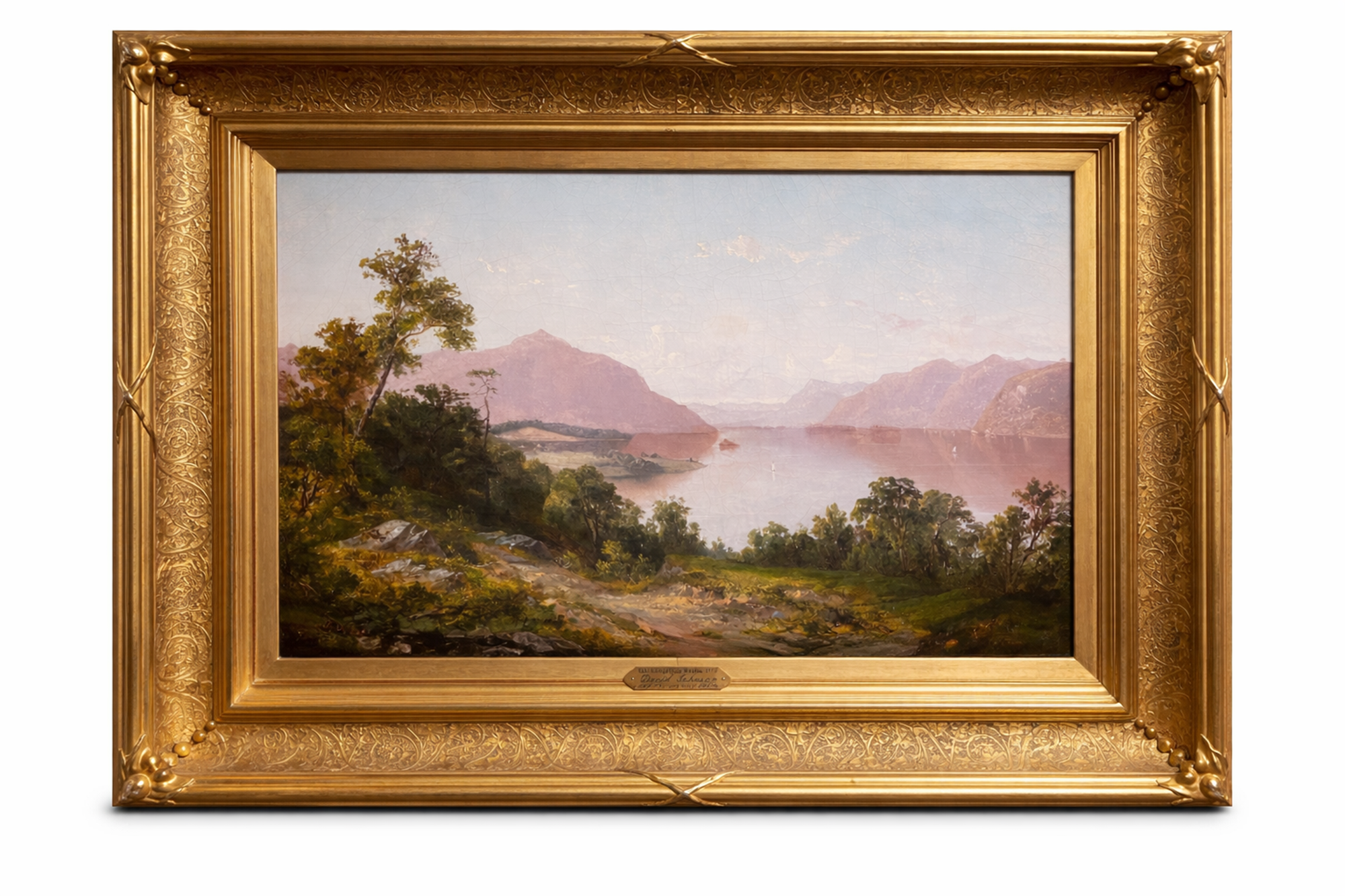
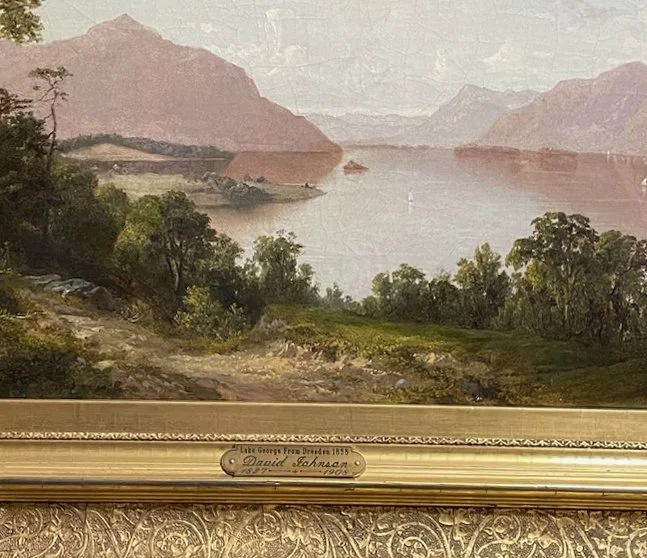



“Lake George”
David Johnson (1827–1908)
Oil on canvas: 14 x 22 inches: Frame: 23 × 31 inches
This finely executed landscape by David Johnson, a distinguished member of the second generation of the Hudson River School, presents a serene and expansive view of a lake set within a mountainous terrain, rendered with characteristic restraint and clarity.
The composition unfolds with a gently descending foreground path, bordered by rock outcroppings and foliage, guiding the eye toward a luminous body of water that occupies the middle distance. Beyond, a sequence of softly receding पर्वत forms—bathed in delicate atmospheric haze—establishes a convincing sense of depth and spatial harmony. The sky, suffused with subtle rose and pale tonalities, suggests either early morning or the waning light of day, imbuing the scene with a quiet, contemplative mood.
Johnson’s handling is notably refined. The brushwork is controlled and deliberate, favoring naturalistic observation over theatrical effect. This approach reflects the influence of Asher B. Durand, under whom Johnson developed a philosophy centered on fidelity to nature. The result is a landscape that is both truthful and poetic—an equilibrium that defines Johnson’s mature work.
David Johnson occupies an important position within the evolution of 19th-century American landscape painting. While earlier Hudson River School artists often emphasized grandeur and sublime drama, Johnson’s work represents a transition toward a more intimate and observational mode. His landscapes are quieter, more measured, and grounded in direct study of the natural world.
The present painting exemplifies this sensibility. Rather than dramatizing the terrain, Johnson presents it with clarity and composure, allowing light, atmosphere, and structure to convey beauty without exaggeration. Such works were particularly sought after by collectors in the latter half of the 19th century for their refined domestic scale and contemplative character.
Significance
This painting represents a compelling example of David Johnson’s mature landscape practice—marked by balance, restraint, and atmospheric sensitivity. Works of this scale and quality embody the shift within the Hudson River School toward a more intimate and enduring vision of the American landscape.
As both an artistic and historical object, the painting holds strong appeal for collectors of 19th-century American art, particularly those drawn to the quieter, more reflective expressions of the Hudson River tradition.
Inquire about this painting