Austrian Biedermeier Long-Duration Standing Regulator by Joseph Hübner, Vienna
Circa 1830-1840
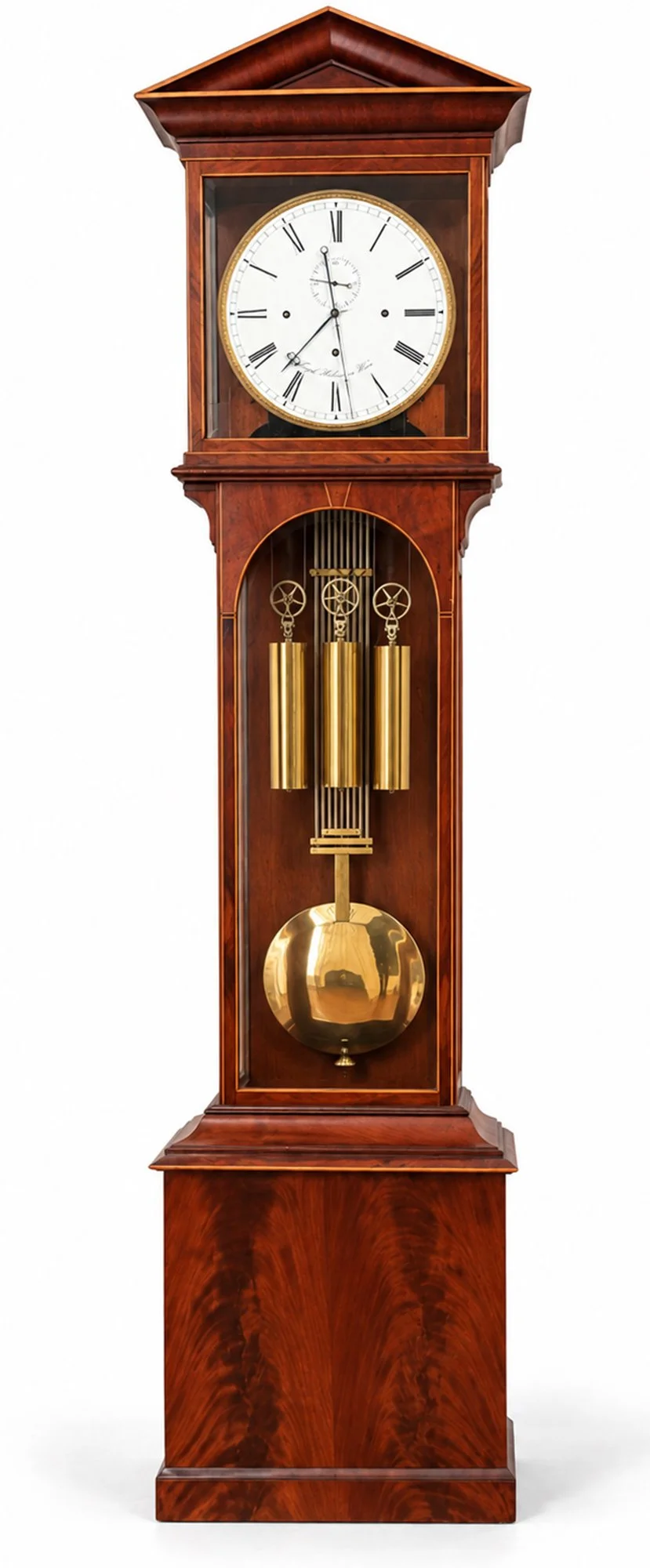
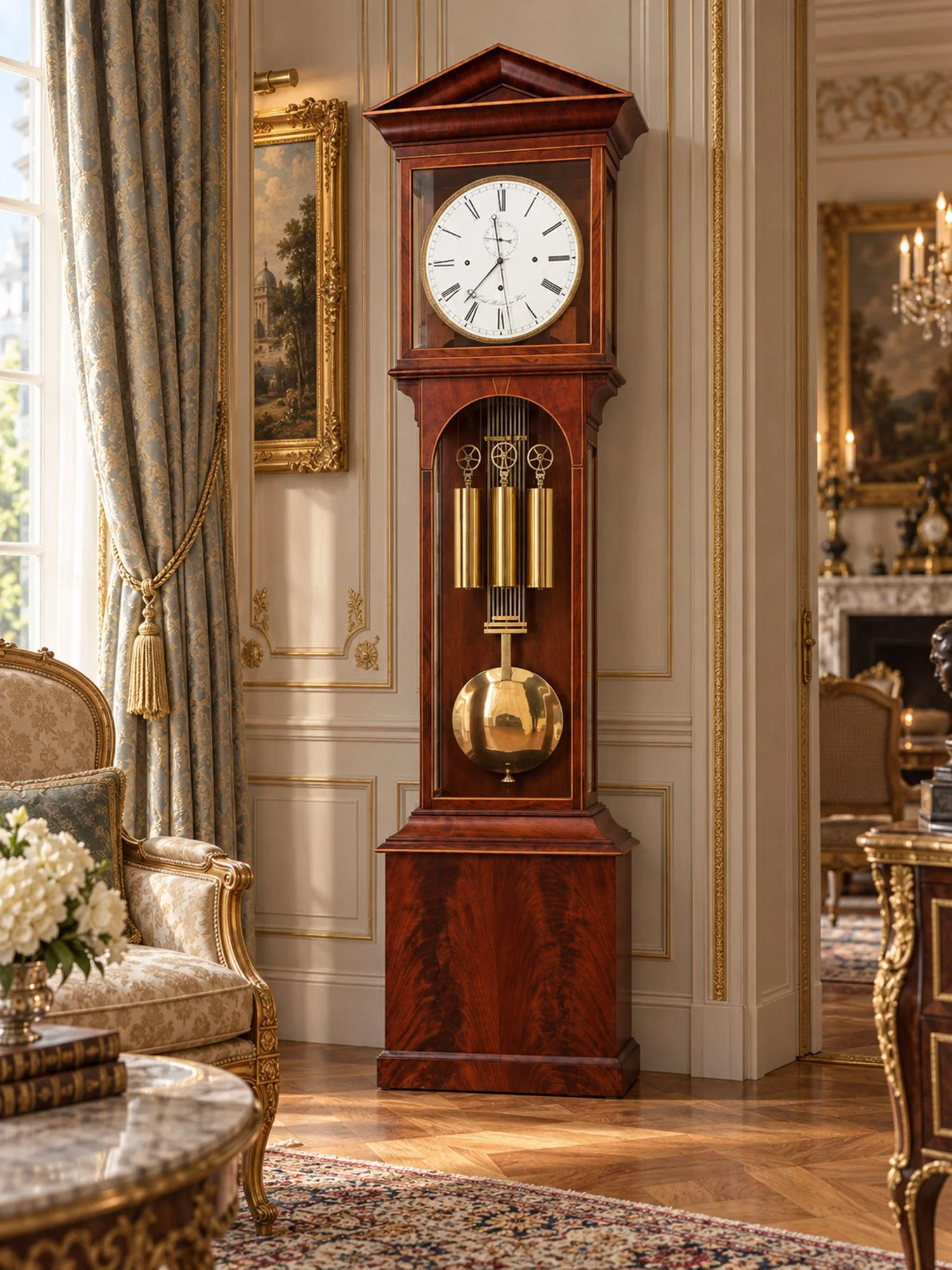
An Important Austrian Biedermeier Long-Duration Three-Train Standing Regulator by Joseph Hübner, Vienna
Circa 1830–1840
Signed “Joseph Hübner in Wien”
Approximately 84 inches high
Approximately one-month duration
An unusually imposing and sophisticated Austrian floor-standing regulator by Joseph Hübner of Vienna, combining the restrained architectural elegance of the Biedermeier period with a remarkably elaborate long-duration, three-train movement.
Standing approximately 84 inches high, the clock is housed within a beautifully proportioned mahogany-veneered case enriched with fine contrasting stringing. Its architectural form is surmounted by a boldly projecting triangular pediment, beneath which the large white enamel dial is displayed within a glazed hood.
The dial is signed in elegant script:
“Joseph Hübner in Wien”
and is surrounded by a finely chased gilt-brass bezel. Black Roman numerals and a finely divided outer minute chapter are complemented by delicately formed steel hands and a subsidiary seconds register positioned beneath XII. Three winding apertures correspond to the clock's substantial three-train movement.
The elongated glazed trunk provides an unusually dramatic view of the clock's mechanism. Three cylindrical brass weights are suspended from finely fashioned openwork pulleys, while the central pendulum incorporates a multiple-rod compensated gridiron assembly terminating in a large polished brass bob.
The purpose of such a compensated pendulum was considerably more than decorative. Changes in temperature cause ordinary metal pendulum rods to expand and contract, altering the effective length of the pendulum and consequently the clock's rate. The use of differing metals arranged within a gridiron structure was intended to counteract these dimensional changes and improve long-term accuracy.
The movement operates for approximately one month on a single winding, placing this clock within the relatively small category of long-duration Viennese regulators. A closely related Hübner standing regulator documented by Schmitt Horan was described as having a six-week three-train movement, Viennese-quarter striking, bimetallic gridiron pendulum and knife-edge suspension.
The three-train configuration is especially noteworthy. Unlike the far more common single-weight time-only Vienna regulator, three separate trains permit the clock to combine timekeeping with an elaborate striking system. The precise striking sequence of the present clock should be confirmed mechanically before cataloguing it definitively as Grande Sonnerie or Viennese-quarter striking.
The lower case is particularly handsome, veneered in strongly figured mahogany selected and arranged to create an almost symmetrical pattern across the broad base. Combined with the slender glazed trunk, richly figured surfaces and temple-like pediment, the case possesses the disciplined architectural character associated with the finest Viennese Biedermeier clockmaking.
Historical Context
Vienna became one of Europe's most important centers of precision domestic clockmaking during the late eighteenth and first half of the nineteenth centuries. The regulator represented a particularly sophisticated expression of the Viennese tradition.
While ordinary domestic clocks needed to provide reliable time and striking, the best Viennese regulators deliberately exposed their mechanical components behind glass. Pendulum, weights, pulleys and suspension system therefore became part of the clock's visual architecture.
The present clock takes that idea to an unusually ambitious scale.
Its 84-inch standing case, rather than the much more frequently encountered wall-mounted format, gives the mechanism the architectural presence normally associated with an important longcase clock while retaining the precision-oriented aesthetic of the Vienna regulator.
Construction and Features
Austrian, Vienna
Joseph Hübner
Circa 1830–1850
Approximately 84 inches high
Figured mahogany-veneered architectural case
Contrasting fine string inlay
Triangular architectural pediment
Extensively glazed hood and trunk
White enamel Roman-numeral dial
Dial signed “Joseph Hübner in Wien”
Subsidiary seconds register
Three winding apertures
Three-train weight-driven movement
Three cylindrical brass weights
Decorative openwork brass pulleys
Long-duration gearing
Approximately one-month duration on a winding
Compensated gridiron pendulum
Large polished brass pendulum bob
Striking mechanism, exact sequence to be mechanically confirmed
Condition
The clock presents exceptionally well in the photographs, retaining a rich surface and particularly attractive figuring to the mahogany veneers. The enamel dial appears notably well preserved overall, while the brass weights, pulleys and pendulum retain a pleasing aged surface.
As with any clock approaching two centuries of age, minor evidence of conservation, adjustment and historic repair should be expected. A detailed examination of the movement, dial reverse and case would be required before making absolute statements concerning originality of every component.
Antique Alliance Commentary
What distinguishes this regulator is the convergence of scale, architecture and mechanical complexity.
Vienna regulators are encountered with some regularity; monumental floor-standing examples by identified makers are considerably less common. Add a three-train long-duration movement, compensated pendulum, subsidiary seconds, elaborate striking capability and an approximately seven-foot architectural case, and the result occupies a distinctly different collecting category.
Rather than concealing its mechanism, Hübner makes the engineering itself part of the composition. Three gleaming weights, delicately formed pulleys and the great compensated pendulum are presented almost as sculpture behind glass.
It is simultaneously a precision instrument, an accomplished piece of Viennese cabinetmaking and an imposing expression of nineteenth-century European horology.
Antique Alliance Asking Price: $24,500