French Figural “Mystery” Clock, Capucine
Circa 1890-1900
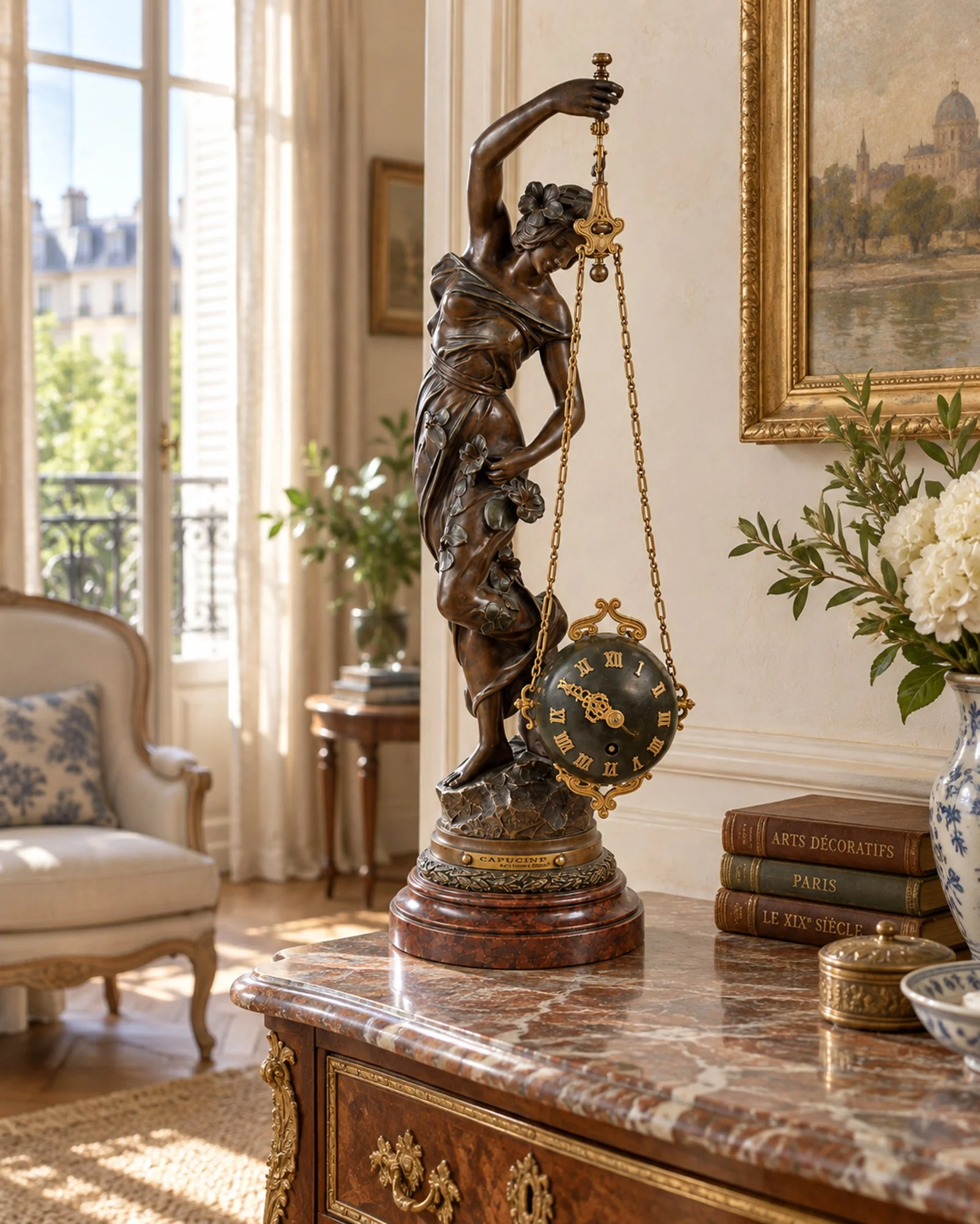
French Figural “Mystery” Clock, Capucine
Model by Julien Caussé (French, 1869–1914)
France, circa 1890–1900
Patinated cast metal, gilt metal, marble, and suspended spherical clock
Height: 24¾ inches
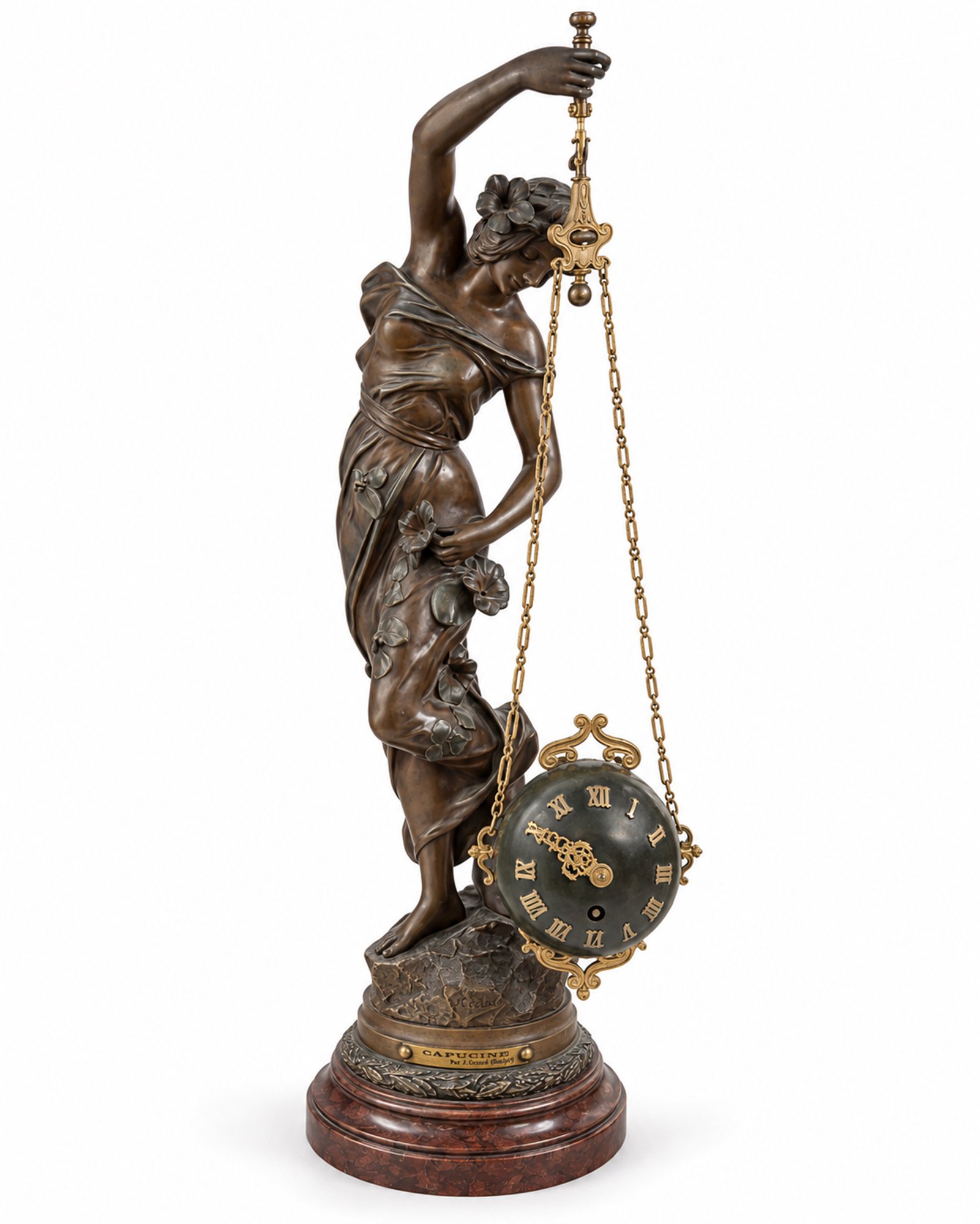
An exceptionally sculptural late-nineteenth-century French figural mystery clock incorporating the model Capucine by Julien Caussé, its title preserved on the original brass plaque mounted to the base.
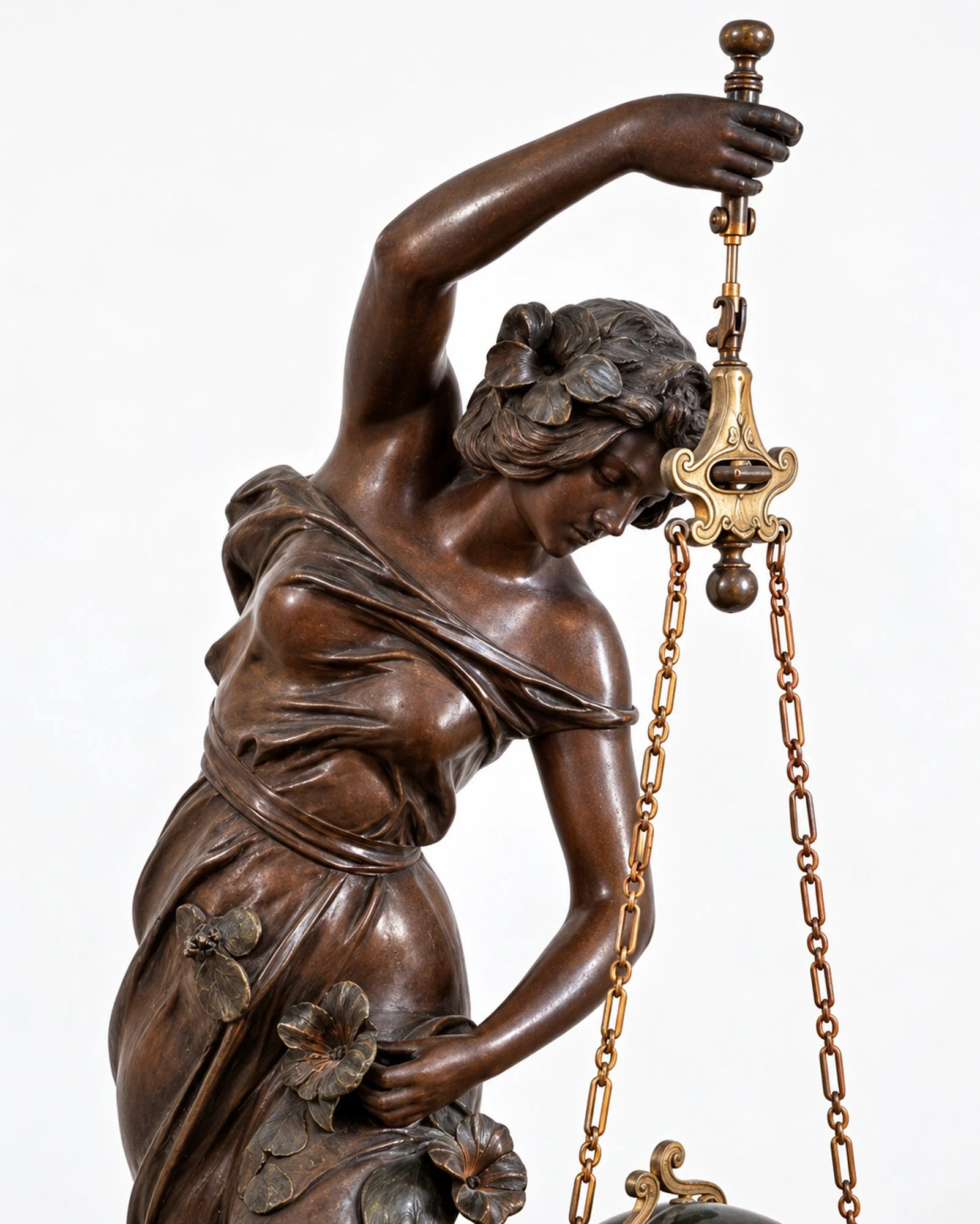
The composition centers on an elegant female figure modeled in flowing drapery and naturalistic floral ornament, her elongated form leaning gracefully beneath an upraised arm. From her hand is suspended the spherical clock by twin chains, creating the dramatic visual effect for which French swinging and conical-pendulum “mystery” clocks became celebrated during the Belle Époque.
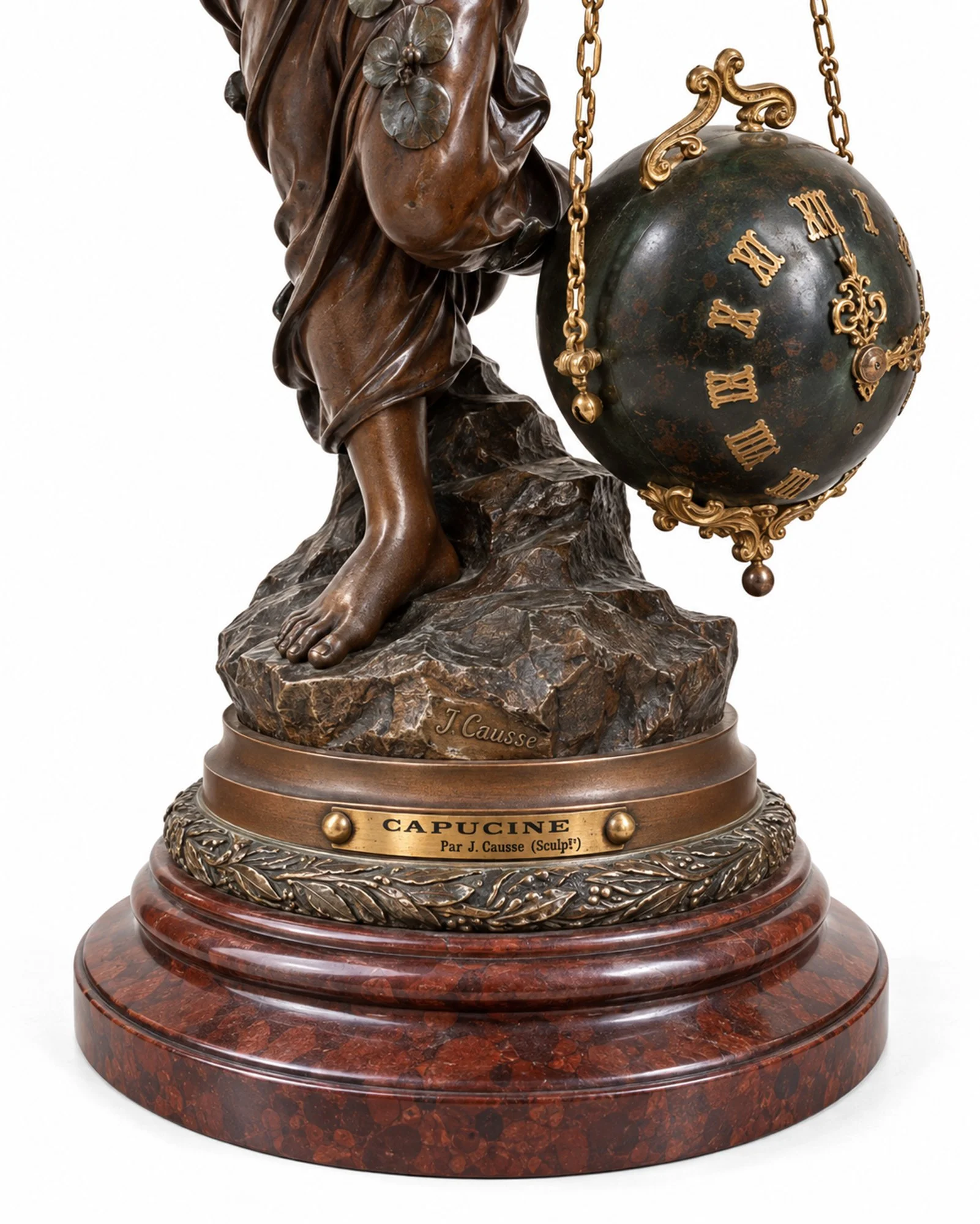
The figure is signed “J. Caussé” in the cast, while the base retains a plaque inscribed:
CAPUCINE
Par J. Caussé (Sculpt.)
The title is particularly appropriate to the modeled flowers cascading across the figure’s gown, capucine being the French word for nasturtium.
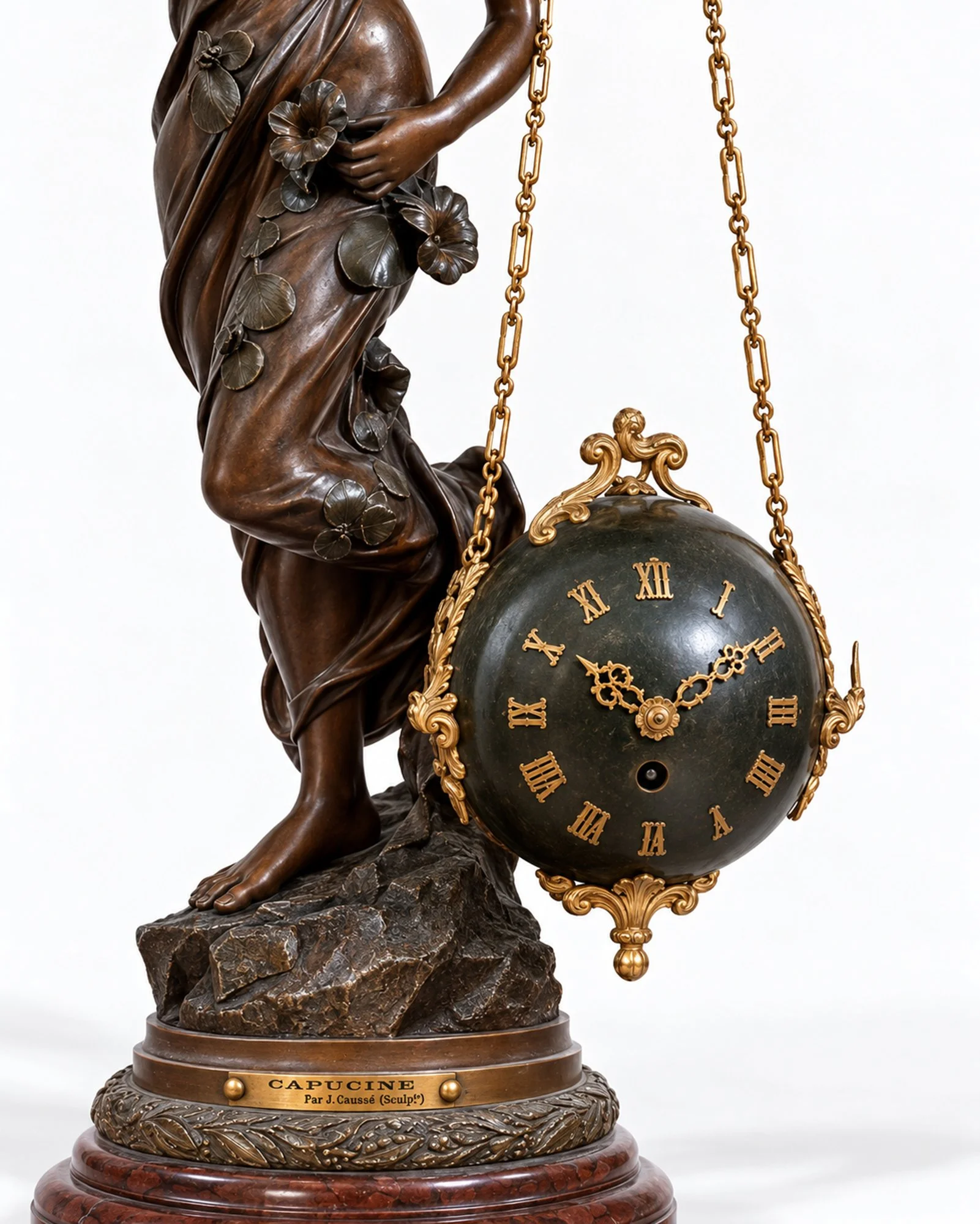
The spherical clock itself is unusually handsome, with a dark patinated surface relieved by individually applied gilt Roman numerals and elaborate pierced gilt hands. Decorative scrolling mounts above and below visually integrate the globe with its suspension system, while the twin chains descend from an ornamental fitting held by the figure’s raised hand.
Unlike a conventional mantel clock, the clock globe forms part of the kinetic composition. In clocks of this type, the suspended sphere slowly moves through a conical or swinging arc while the movement remains contained within the globe, giving the mechanism an apparently unsupported, almost theatrical quality.
The figure rises from a molded rocky support above a substantial circular red marble base, probably griotte, enriched with a cast foliate collar and the original title plaque. The warm marble, dark brown patination of the figure, gilt fittings, and black spherical timepiece create a sophisticated and highly decorative contrast.
Julien Caussé
Julien Caussé was active in France during the final decades of the nineteenth century and the opening years of the twentieth. He became particularly associated with allegorical and female figures conceived in the naturalistic vocabulary of the Belle Époque and emerging Art Nouveau.
His sculptural models were adapted into a variety of decorative objects, including lamps, figural bronzes and elaborate clocks. Signed examples frequently combine graceful female forms with flowers, foliage and allegorical attributes.
The survival of both the cast Caussé signature and the original Capucine title plaque gives this clock considerably greater documentary interest than an anonymous figural mystery clock of the period.
Mechanical Attribution
The suspended spherical arrangement belongs to the sophisticated family of French swinging and conical-pendulum mystery clocks developed in the late nineteenth century.
Closely related Caussé figural clocks are known with mechanisms associated with André Romain Guilmet of Paris, one of the leading French makers of novelty and mystery clocks during this period.
The present clock is therefore stylistically and mechanically related to Guilmet-system clocks; however, until the movement itself is examined for signatures, patent marks or identifying numbers, the mechanism should conservatively be described as:
French mystery-clock mechanism, possibly employing the Guilmet system.
Materials and Construction
Patinated cast figure, probably régule/spelter
Gilt-metal suspension and decorative fittings
Suspended spherical clock case
Applied gilt Roman numerals
Pierced gilt hands
Twin suspension chains
Circular red marble base, probably griotte
Cast foliate collar
Original brass title plaque
Signed in the cast “J. Caussé”
Plaque inscribed “CAPUCINE / Par J. Caussé (Sculpt.)”
Approximately 24¾ inches high
The clock presents exceptionally well, retaining a rich dark brown patination to the figure and strong contrast between the sculpture, gilt mounts and marble base. The spherical timepiece retains its applied numerals, hands, suspension chains and decorative fittings.
Collector’s Note
The appeal of this clock lies in the unusually successful union of sculpture and horology. The figure does not merely support the clock; the entire composition is conceived around the illusion of the suspended sphere, making movement itself part of the sculptural design.
The named Capucine model, surviving Caussé signature and original title plaque add an important degree of attribution and scholarship, while the dark suspended globe gives the object a striking silhouette unlike more conventional French mantel clocks.
A highly decorative and unusual example of late nineteenth-century French mechanical design, combining the work of a recognized sculptor with one of the era’s most inventive forms of mystery clock.
Inquire about this Clock