Jones A. Jones & Co. Monumental Astronomical Regulator
Circa 1870
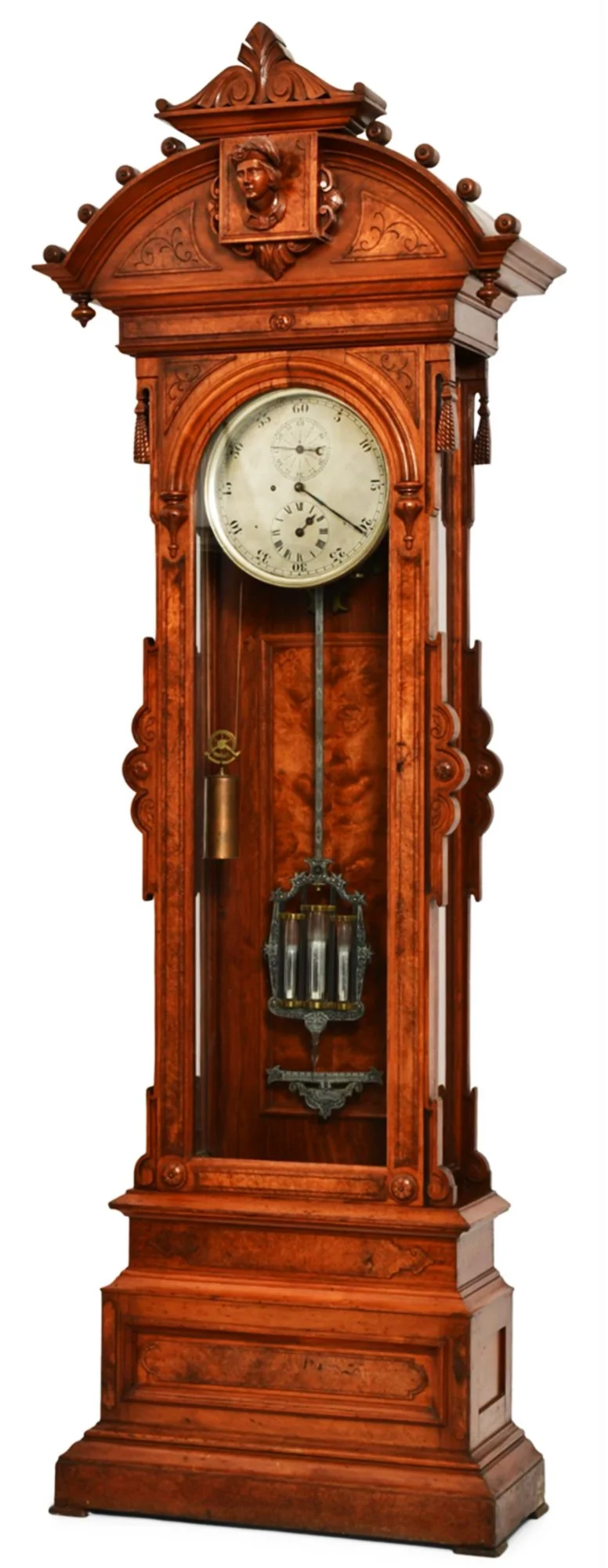

George A. Jones & Co. Monumental Astronomical Regulator
New York, circa 1870
American Victorian / Renaissance Revival
Walnut, burl walnut, silvered brass dial, precision weight-driven movement, three-jar mercurial compensating pendulum
Height: 111 inches
An extraordinary monumental American astronomical regulator by George A. Jones & Co. of New York, standing an imposing 111 inches high and retaining its original case, dial, movement, pendulum, weight, and decorative fittings.
Among the most ambitious clock forms produced by George A. Jones & Co., this regulator combines precision horology with the scale and architectural presence of high Victorian cabinetmaking. The clock is housed in an elaborate walnut case enriched with figured burl veneers, carved and incised ornament, and a monumental arched crest centered by a carved classical bust.
The regulator’s extraordinary 9-foot-3-inch height, astronomical dial arrangement, and signed three-jar compensating pendulum place it well beyond the firm's more familiar wall regulators and parlor clocks. A closely documented George Jones astronomical regulator of virtually identical monumental scale—111 inches high—has been recorded with the same 6 Courtlandt Street marking and a three-jar mercury pendulum
The Case
The architectural case is constructed primarily of black walnut, with richly figured burl walnut panels and extensive carved and incised decoration.
The massive pediment is formed as a broad broken arch edged by a sequence of turned bosses and centered by a projecting rectangular panel containing the carved bust of a classical female figure. Above, a carved foliate crest rises from the cornice, while small pendant ornaments and geometric incised decoration animate the surrounding surfaces.
Below the pediment, the dial is framed by a deeply molded circular surround and flanked by carved architectural elements. The long glazed trunk is articulated by narrow uprights, applied carved terminals, scrolling side brackets, and figured veneered panels. The case terminates in a substantial stepped plinth base with further figured burl panels and molded architectural framing.
Despite its monumental scale, the case is exceptionally well proportioned. The narrow vertical trunk, elevated dial, and massive plinth create the impression of an architectural monument rather than simply an enlarged clock cabinet.
Astronomical Dial
The large silvered dial is arranged in the traditional astronomical-regulator format, designed for precise and immediate reading.
The principal indications comprise:
a large central minute hand
a subsidiary seconds dial at 12 o’clock
a subsidiary hour dial at 6 o’clock
an outer minute chapter ring
This separated display allows hours, minutes, and seconds to be read independently, a configuration historically associated with precision regulators used in observatories, jewelry establishments, railway offices, and other settings where accurate timekeeping was essential.
A comparable documented George A. Jones monumental astronomical regulator is recorded with an 18-inch silvered dial and the same specialized precision-clock format.
Precision Movement
The clock is fitted with a substantial eight-day, weight-driven precision movement.
George A. Jones's better regulators are documented with sophisticated features including maintaining power and, in some models, pinwheel escapements. A surviving George A. Jones Regulator No. 1 has been documented with an eight-day movement incorporating pinwheel escapement and maintaining power, illustrating the high mechanical standard reached by the firm.
A virtually identical monumental Jones astronomical regulator has been catalogued with a substantial weight-driven timepiece movement and Graham deadbeat escapement, together with the same type of three-jar mercurial pendulum.
The present movement and regulating system are original to the clock.
Three-Jar Mercurial Compensating Pendulum
One of the clock’s most remarkable features is its elaborate three-jar mercurial temperature-compensating pendulum.
The pendulum incorporates three vertically arranged glass cylinders, the center jar larger than the two flanking jars, held within an intricately engraved metal frame. The frame is decorated throughout with scrolling foliate ornament and terminates in highly ornamental upper and lower brackets.
The pendulum is engraved:
George A. Jones & Co.
No. 6 Courtlandt St.
New York
The address is significant. George A. Jones & Co. is documented at Nos. 2, 5, and 6 Cortlandt Street in New York between approximately 1864 and 1872, when the firm was producing walnut parlor clocks and a small number of large standing and wall regulators with high-grade movements.
The glass cylinders were designed to contain mercury. In a mercurial compensation system, the thermal expansion of the mercury offsets the lengthening of the pendulum rod caused by rising temperature, helping preserve a constant effective pendulum length and therefore more accurate timekeeping.
Below the pendulum is an elaborately engraved rating scale and index, allowing minute adjustment of the regulator.
The sophistication and decorative quality of this pendulum make it both a functional precision instrument and an important decorative object in its own right.
George A. Jones & Co.
George Alfred Jones established his New York clock concern in the 1860s. Contemporary directory evidence and later scholarship place the company at several Cortlandt Street addresses in New York between 1864 and 1872. The firm produced walnut parlor clocks as well as a relatively small number of large wall and standing regulators fitted with high-quality movements.
Around 1870 Jones established a factory at Bristol, Connecticut, principally for shelf-clock production. Surviving evidence indicates that the large precision regulators were associated primarily with the New York operation rather than mass production at Bristol.
After the New York Jones operation declined, Henry J. Davies and later James Wood & Co. continued aspects of the firm's clockmaking tradition. An 1874 New York business directory explicitly listed Henry J. Davies at 5 Cortlandt Street as successor to George A. Jones & Co.
Inquire about this Clock