Monumental Louis XVI Gilt-Bronze and White Marble Military Calendar Portico Clock by Pierre Robinet, Paris
France circa 1780-1790
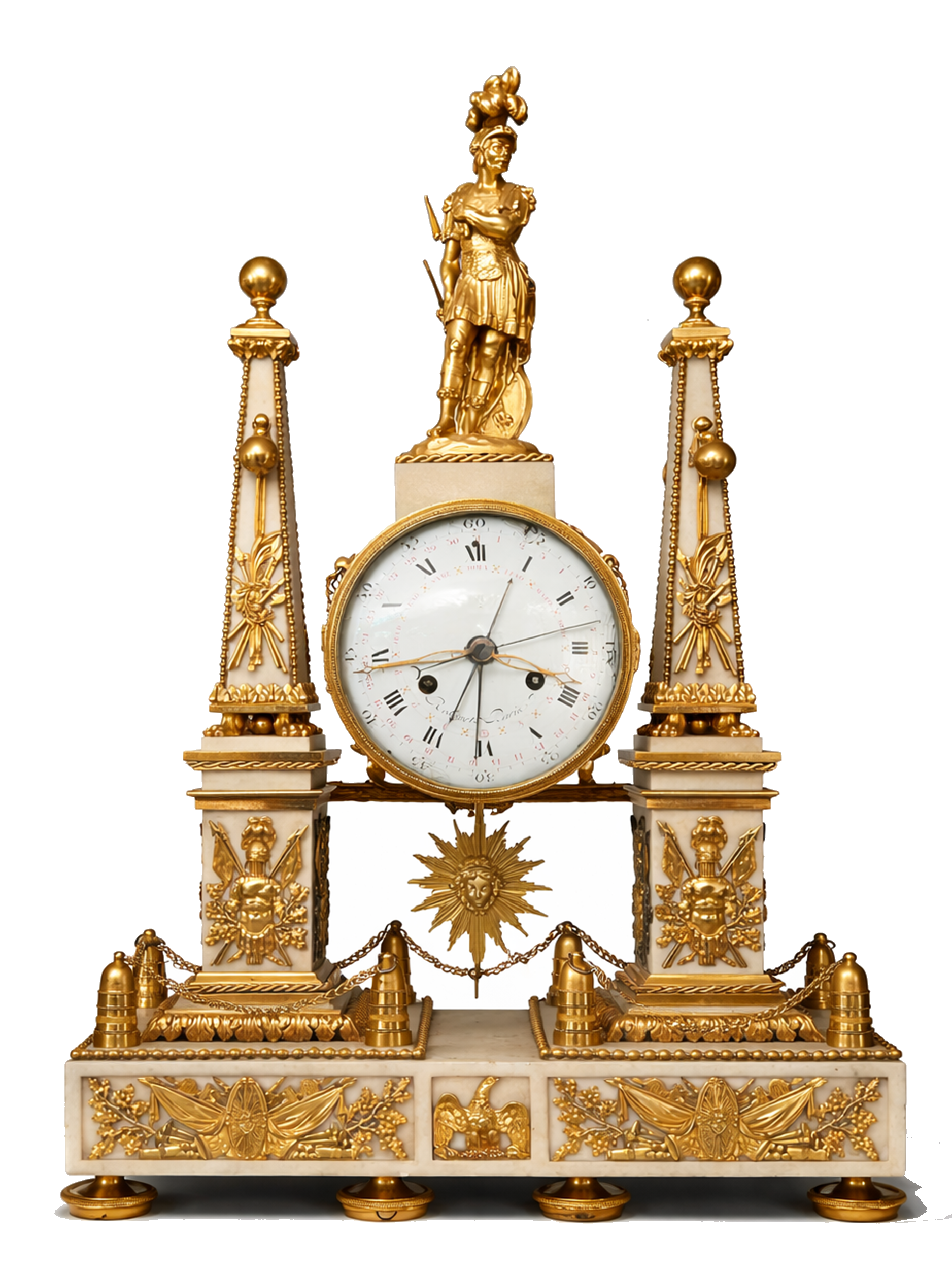
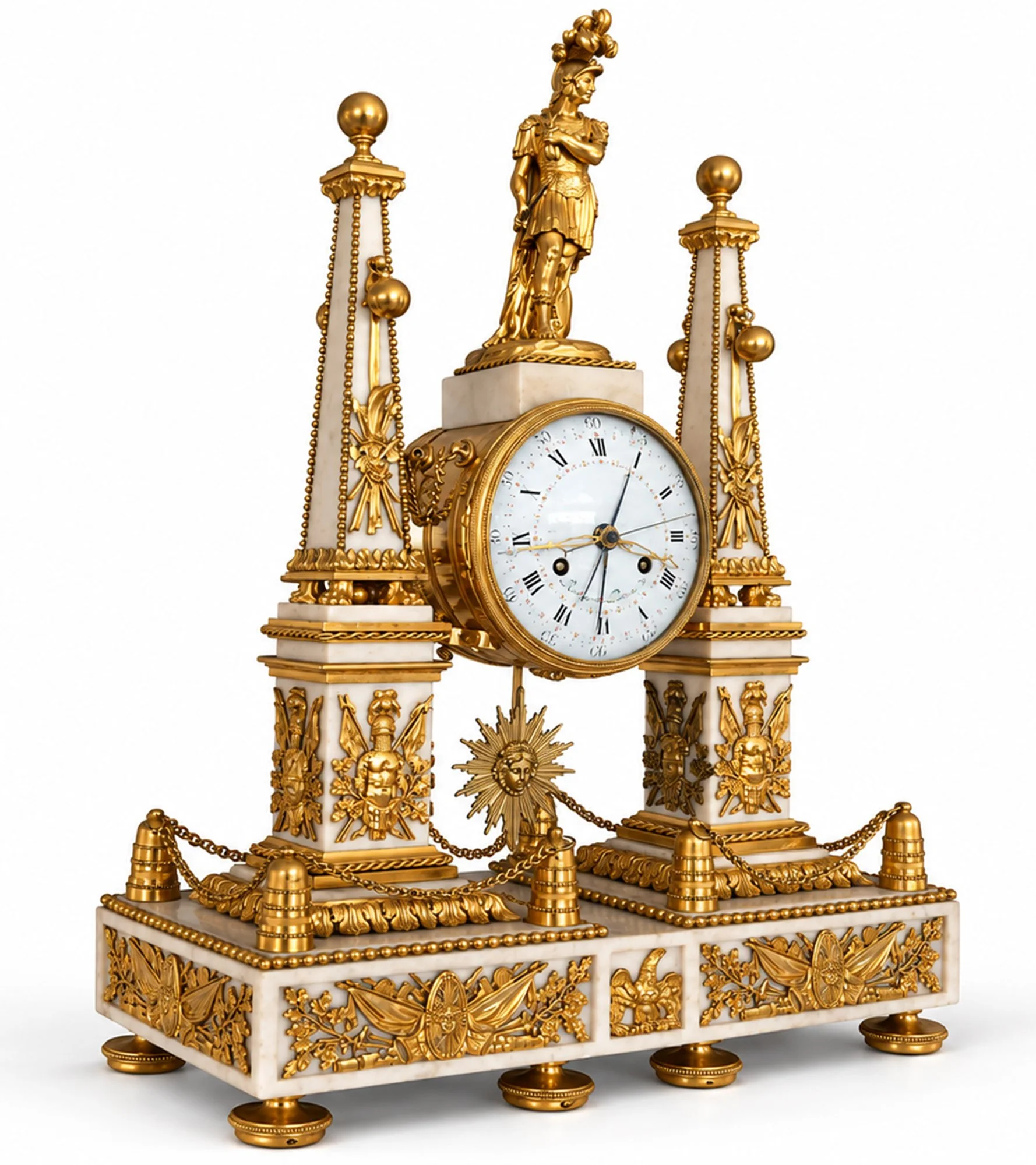
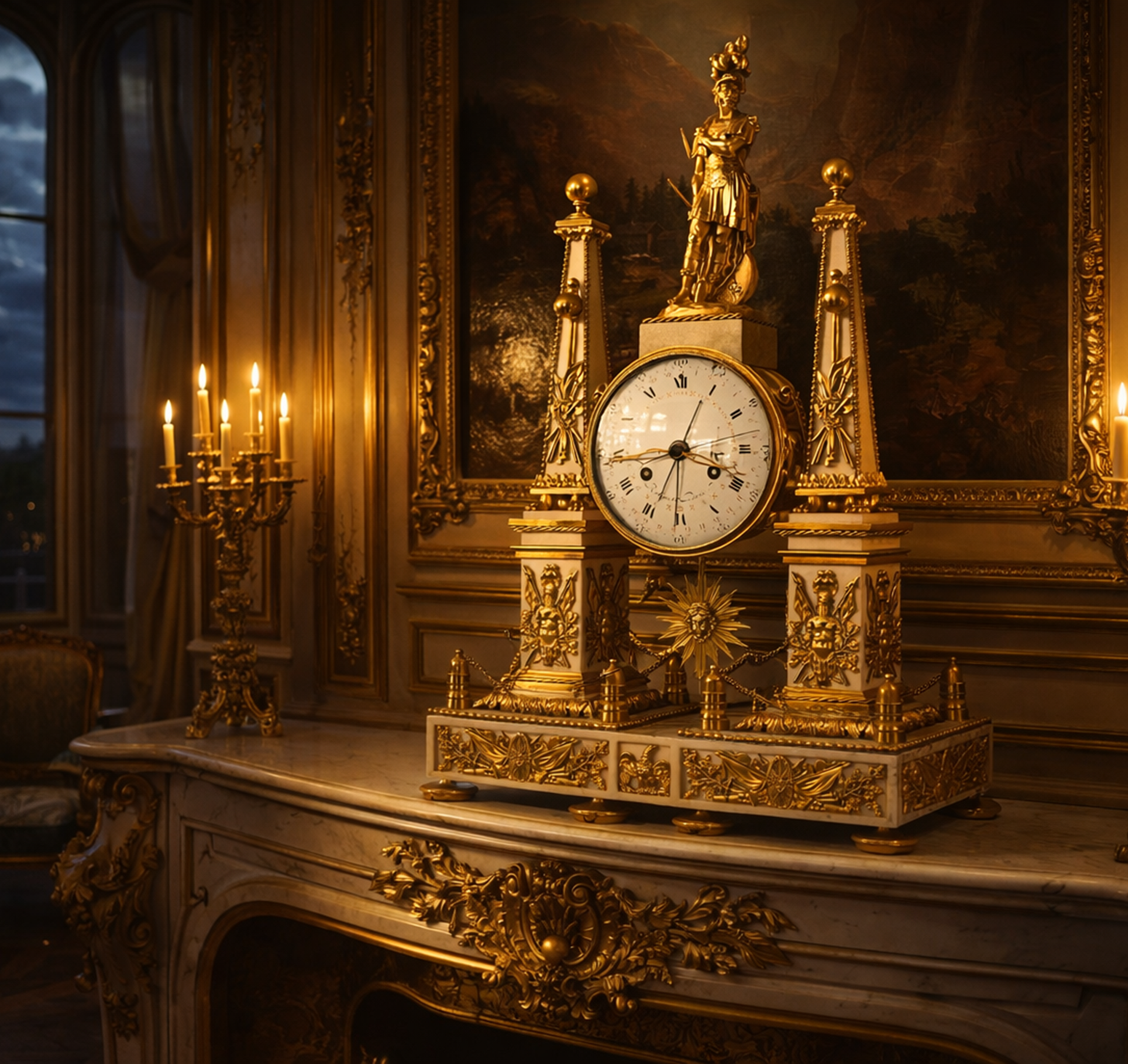
A Monumental Louis XVI Gilt-Bronze and White Marble Military Calendar Portico Clock by Pierre Robinet, Paris
France, circa 1780–1790
Signed “Robinet à Paris”
Height: 28 inches / approximately 71 cm
An exceptionally elaborate and unusually large French Louis XVI architectural calendar clock in white marble and finely chased gilt bronze, the enamel dial signed Robinet à Paris, attributable to Pierre Robinet, maître horloger in Paris from 1776.
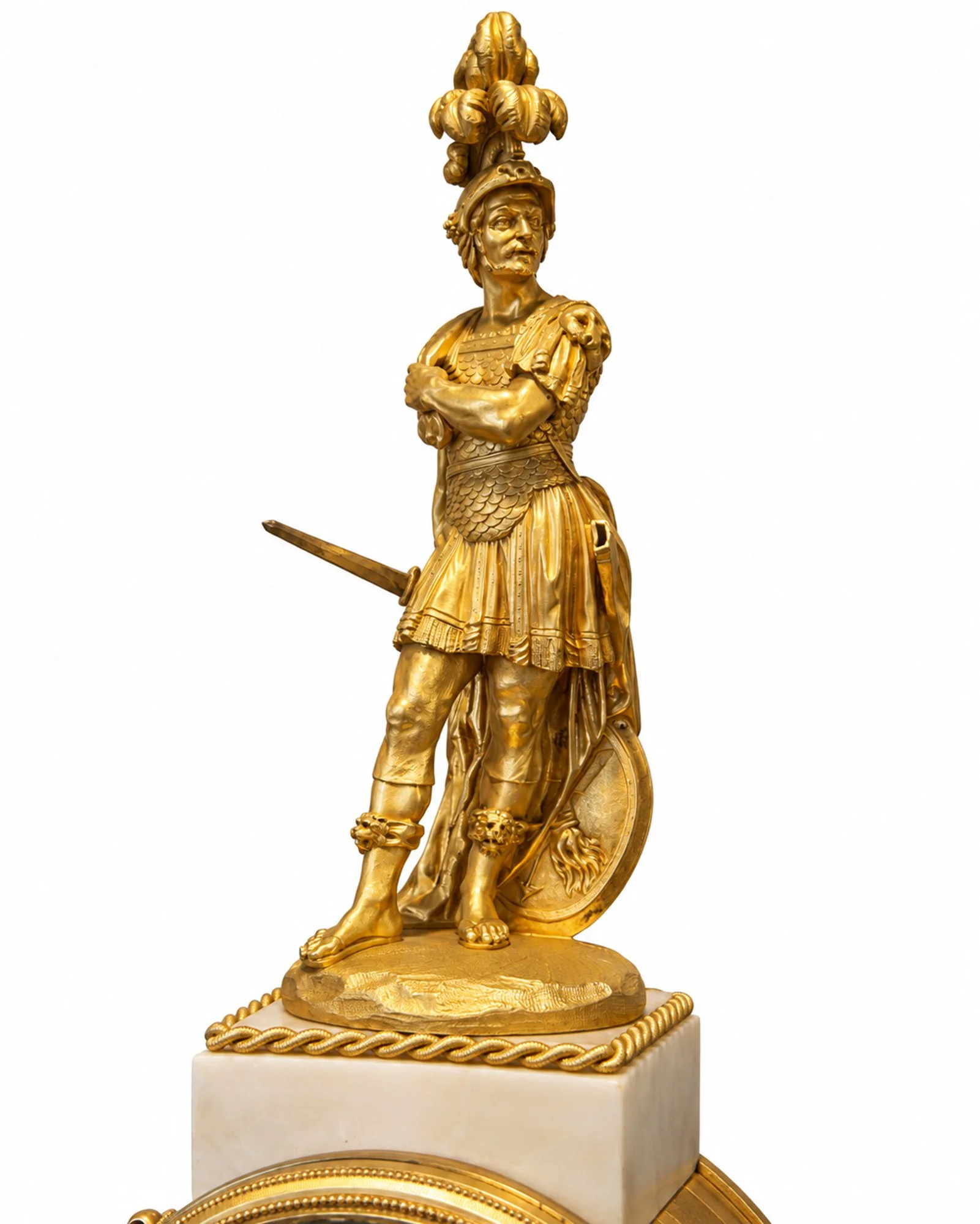
Conceived as a neoclassical military monument, the clock is centered by a large circular enamel dial supported between two tall tapering marble pylons enriched with gilt-bronze military trophies, beadwork, foliage, arms, and standards. Above the dial stands a finely modeled gilt-bronze figure of a helmeted classical warrior, probably Minerva, emblematic of wisdom, disciplined power, and military strategy.
The extensive gilt-bronze decoration continues throughout the composition. The lower architectural base is applied with martial trophies incorporating armor, standards, weapons, artillery imagery, drapery, foliage, and a prominent central eagle. A series of gilt-bronze posts linked by chains surrounds the raised platforms, giving the clock the appearance of a formal commemorative monument.
The visual vocabulary is unmistakably that of the later Louis XVI period, when the restrained geometry of neoclassicism was increasingly combined with imagery drawn from classical warfare, civic virtue, and military triumph.
The Complicated Enamel Dial
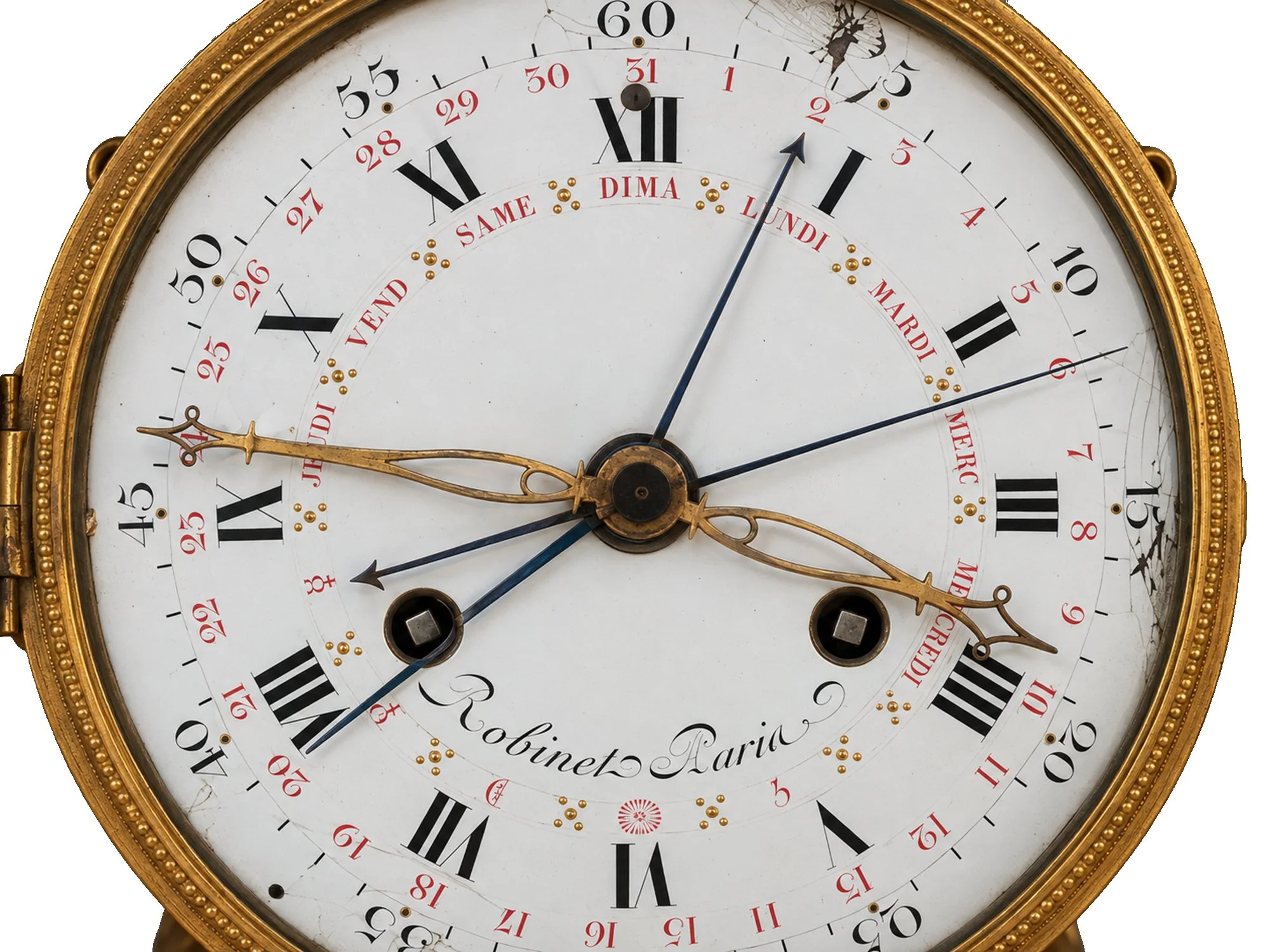
The large white enamel dial is one of the most remarkable elements of the clock.
It displays conventional Roman numerals for the hours, surrounded by a finely calibrated outer 1–60 scale, together with a red 1–31 calendar ring for the days of the month.
An additional inner ring records the days of the week in French:
DIMANCHE – LUNDI – MARDI – MERCREDI – JEUDI – VENDREDI – SAMEDI
Multiple central hands perform the time and calendar indications. The pair of elaborately pierced gilt hands displays the hours and minutes, while the additional blued-steel hands serve the supplementary calendar and/or seconds indications.
Two winding apertures indicate separate going and striking trains.
The combination of a signed Robinet dial with multiple calendar indications places the clock mechanically above the conventional decorative French portico clock. Robinet is known to have produced sophisticated calendar clocks: a documented Louis XVI lyre clock by him, dating circa 1780–1785, incorporates indications for hours, minutes, and the date of the month.
Pierre Robinet
Pierre Robinet is documented as a Parisian clockmaker born in 1751 and received as a maître horloger in 1776. He is recorded working at rue Greneta in Paris from 1778 to 1789.
Surviving clocks bearing his signature demonstrate his association with sophisticated late-Louis XVI objects in white marble and gilt bronze.
Of particular relevance is a documented Louis XVI military-attributes clock signed Robinet à Paris, constructed in white marble and mercury-gilt bronze, with military trophy mounts and a classical military figure. The specialist dealer identifies it as Louis XVI, circa 1775–1790, and describes its movement as original and unmodified.
Christie's has also catalogued a late-18th-century Directoire portico clock signed by Pierre Robinet, with its enamel dial signed by the important enameller Étienne Gobin, called Dubuisson.
Robinet's documented working period, the elaborate Louis XVI military vocabulary, white marble, mercury-gilt bronze decoration, beadwork, obelisk-like pylons, chains, and sophisticated enamel calendar dial all point toward the later reign of Louis XVI, perhaps extending into the earliest Revolutionary years.
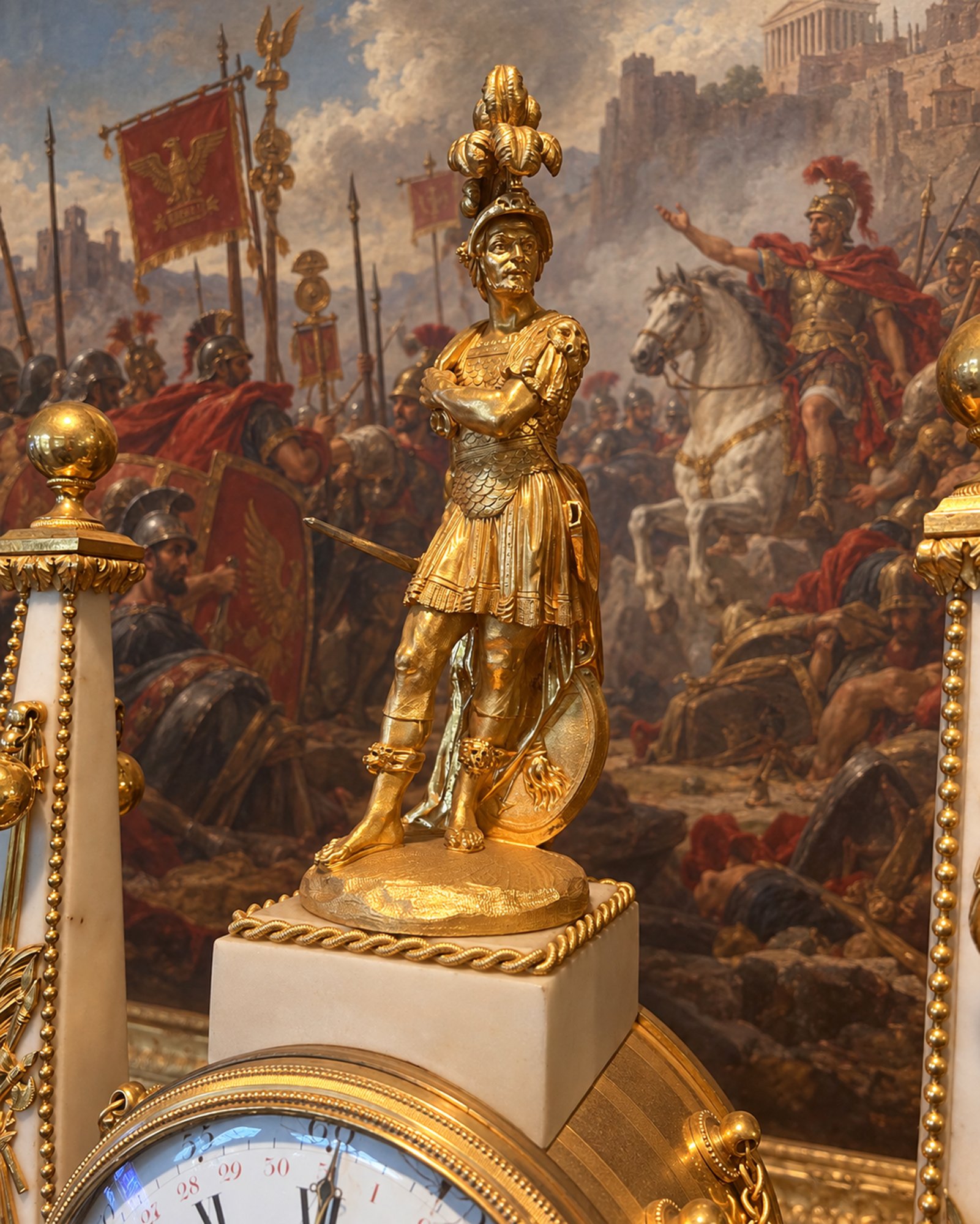
The Warrior
A gilt bronze Roman soldier stands above the dial in a plumed helmet and a cuirass of overlapping scales. One arm is drawn across his chest in a protective gesture, while the other hand grasps the hilt of his sword. His shield rests against his leg, and lion-head bands circle his legs above the ankle. A leather-fringed tunic completes the dress. The chasing is crisp, from the scale armor and the fringe to the beard and the textured ground beneath his feet. His wary stance makes him seem to stand watch over the hours.
Clocks of this scale and ambition were commissioned by connoisseurs. Here the best bronze chasing and gilding, fine marble, and a sophisticated movement came together in a single design. For a collector, the combination of a complex movement, a coherent classical program, and a fine Parisian signature is difficult to find.
Inquire about this Clock