Important French Exhibition Perpetual Calendar Skeleton Clock
Robert, 19 Boulevard Saint-Denis, Paris, circa 1839
An Important French Exhibition Perpetual Calendar Skeleton Clock
Robert, 19 Boulevard Saint-Denis, Paris | 1839
France, Louis-Philippe Period
Dated 1839
Signed: Robert, Horloger, Boulevard St. Denis 19, Exposition 1839
Height: approximately 20½ inches
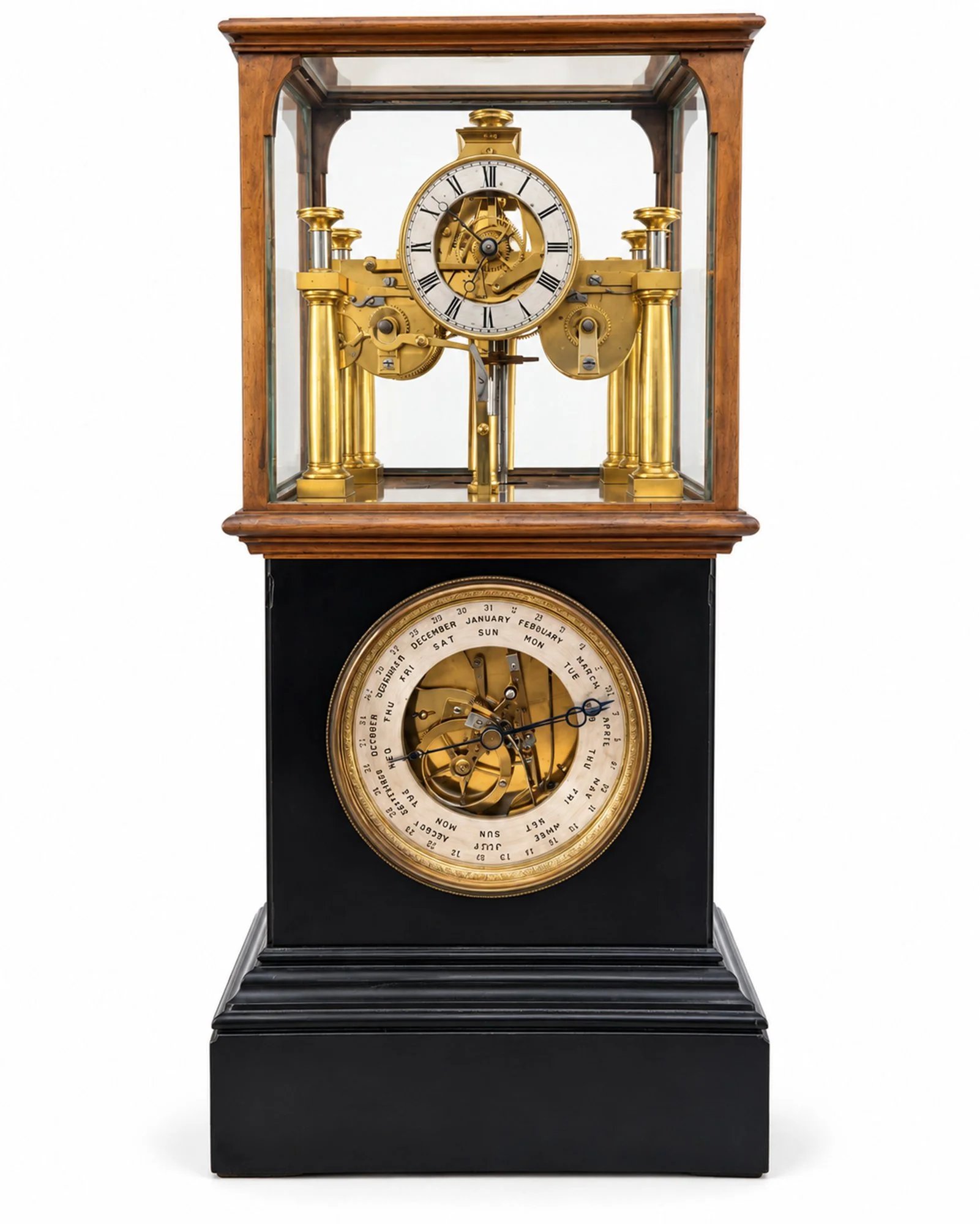
An exceptionally rare and mechanically sophisticated French perpetual calendar skeleton clock, made in Paris in 1839 and inscribed in association with the Exposition des Produits de l’Industrie Française of 1839.
The clock combines two distinct but visually integrated mechanical systems: an architectural skeletonized timekeeping movement displayed beneath glass above, and an elaborate perpetual calendar mechanism housed within the black slate pedestal below.
The upper movement is arranged in the manner of a miniature architectural or turret clock. Substantial gilt-brass pillars support the exposed train, allowing the construction and operation of the mechanism to remain deliberately visible. At its center is an open-work silvered chapter ring with Roman numerals and finely formed blued steel Breguet-type hands.
The movement is of two-week duration and incorporates a half-seconds beating pendulum, jeweled deadbeat escapement and countwheel-controlled hour striking mechanism—features indicative of a clock conceived as an exhibition of horological skill rather than simply a domestic timepiece. Skinner likewise catalogued these features when the clock appeared there in 2011.
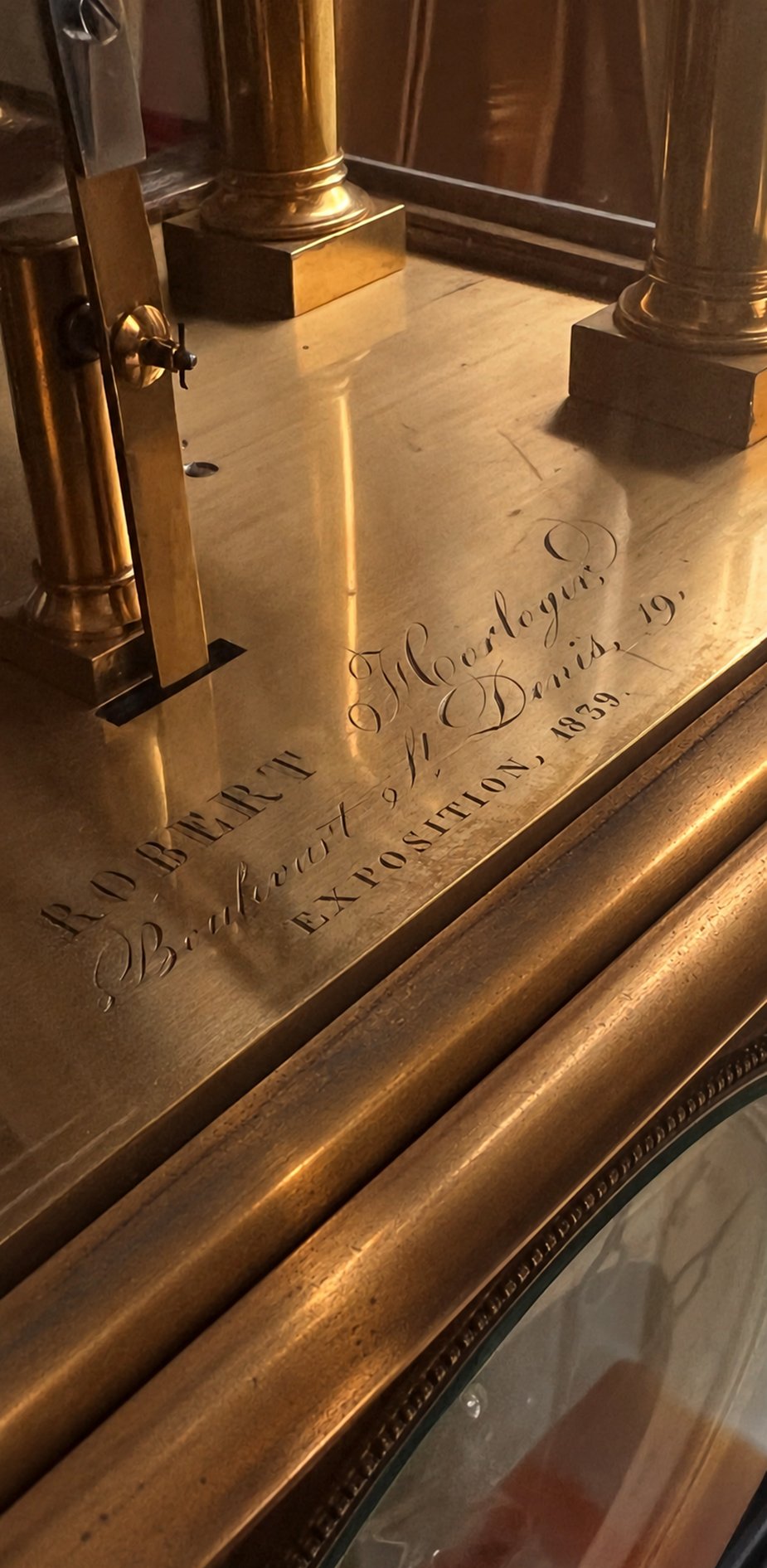
The brass platform is engraved:
ROBERT
Horloger
Boulevard St. Denis 19
Exposition 1839
The inscription is particularly significant, connecting the clock directly with the celebrated French industrial exhibition held in Paris in 1839.
The Perpetual Calendar
The lower portion of the clock contains its most intellectually ambitious feature: a fully mechanical perpetual calendar.
Set within the restrained black slate pedestal is a large silvered circular calendar dial surrounding an exposed mechanism of wheels, springs and steel levers. Concentric indications provide the date of the month, month of the year and day of the week, while the underlying mechanism was designed to account automatically for the changing lengths of the calendar months and the four-year leap-year cycle. Skinner specifically described the calendar as self-correcting through that cycle.
Unlike an ordinary calendar clock requiring manual correction at the conclusion of a short month, the perpetual system embodies the irregular Gregorian calendar mechanically.
The clock consequently represents not merely decorative horology, but an early nineteenth-century demonstration of mechanical computation: the calendar itself translated into wheels, cams, levers and predetermined mechanical relationships.
The 1839 Paris Exhibition
The engraved reference to “Exposition 1839” is central to the clock's historical importance.
The Exposition des Produits de l’Industrie Française was one of nineteenth-century France's major showcases for technical innovation, manufacturing and the decorative arts. Horologists used such exhibitions to demonstrate advances in precision timekeeping, complications and mechanical ingenuity.
Research accompanying the clock when offered at Skinner concluded that it was likely associated with the 1839 Paris Exposition. Skinner further recorded that its mainsprings were signed and dated 1839, providing important physical corroboration of the clock's period manufacture.
Its exposed movement and conspicuous perpetual-calendar mechanism are entirely consistent with an object intended to demonstrate its maker's technical abilities before an informed exhibition audience.
Provenance
Cottone Auctions, New York
28 April 2006, Lot 78
Sold for $36,300
Literature
F. B. Royer-Collard
Skeleton Clocks
London, 1969
p. 72, illustrated and discussed
The identification of the present clock in Royer-Collard is particularly important. It establishes the clock not merely through auction records but within the recognized scholarly literature devoted to skeleton clocks.
Inquire about this clock