Monumental French Cupid and Psyche Calendar Clock
Circa 1870
Monumental French Cupid and Psyche Calendar Clock
After the Model by Claude Michallon
Paris, circa 1870–1890
Patinated bronze, gilt bronze, variegated pink marble, brass, glass
Dial signed STREEL / Rue St. Denis 362. à Paris
Height: 39½ in. (100.3 cm)
Provenance
Christie’s, New York, 21 October 2008, Sale 2034, Lot 355
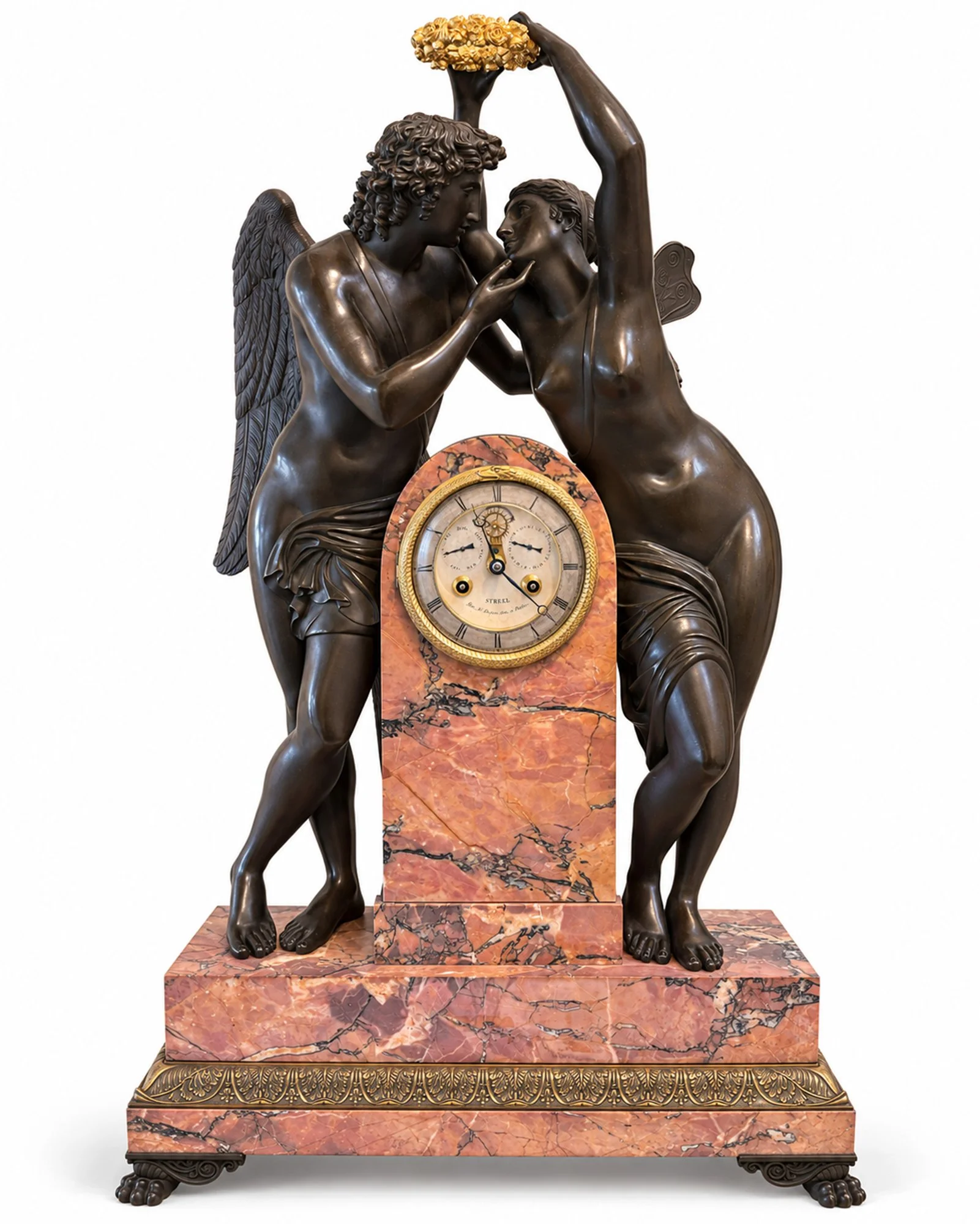
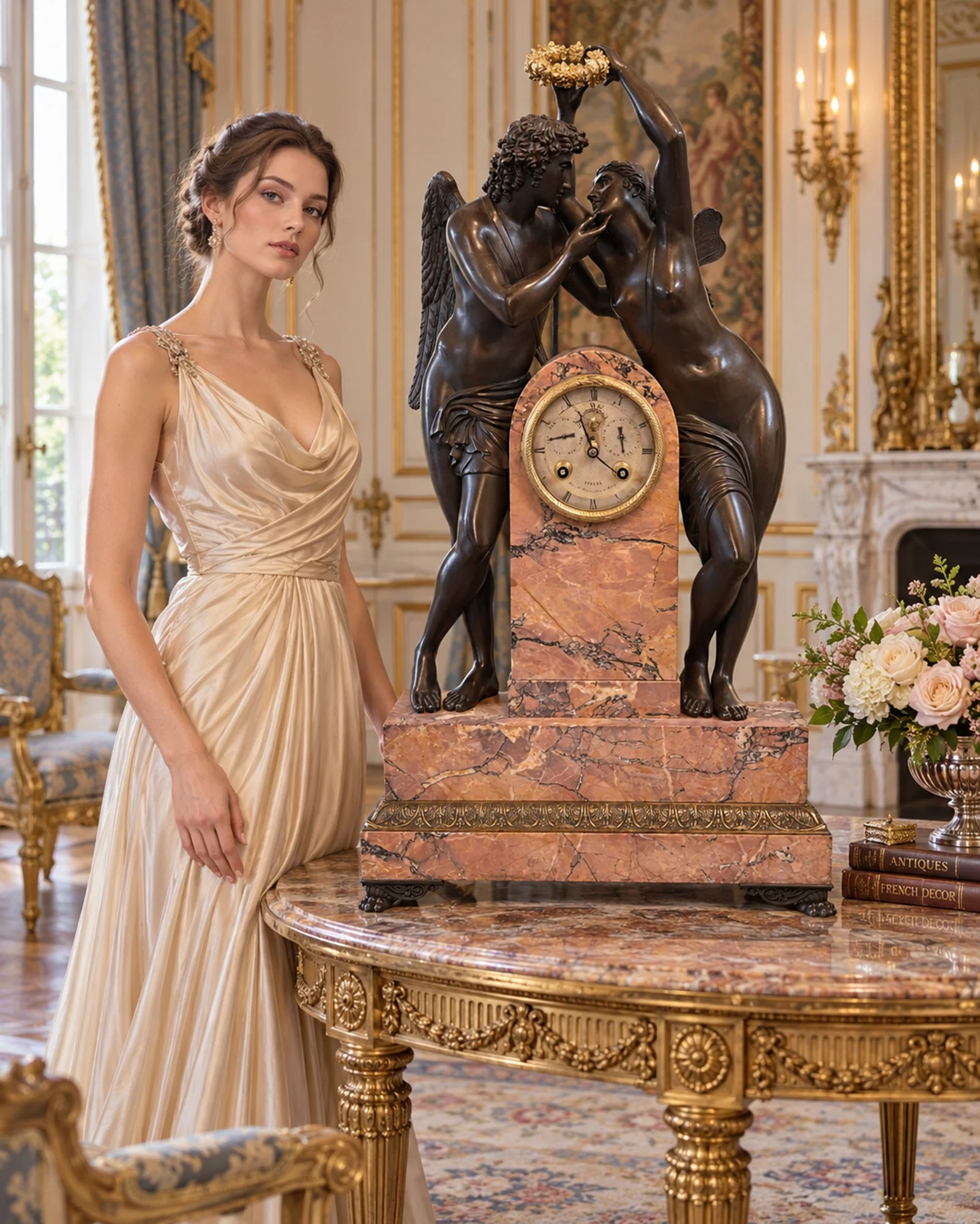
A monumental French figural calendar clock of exceptional sculptural ambition, conceived as an architectural and allegorical composition centered upon Cupid and Psyche. Executed in the late nineteenth century after the celebrated sculptural model associated with Claude Michallon (1751–1799), the clock unites large-scale bronze sculpture, richly figured marble, gilt-bronze ornament, and sophisticated horology in a single imposing work.
The composition is dominated by the nearly life-like interaction of the two patinated bronze figures. Cupid, identifiable by his feathered wings, leans toward Psyche in an intimate embrace, gently raising his hand toward her face. Psyche inclines toward him while extending one arm dramatically overhead, where she supports a finely modeled gilt floral wreath. Her small butterfly-like wings allude to the ancient Greek association of psyche with both the soul and the butterfly.
The sculptural group is arranged around a tall, arched clock housing veneered in richly variegated pink marble, whose salmon, rose, cream, gray and black veining provides a vivid chromatic counterpoint to the deep brown-black patination of the figures. The contrast between polished stone, dark bronze and selectively gilded ornament is characteristic of ambitious French decorative art of the later nineteenth century.
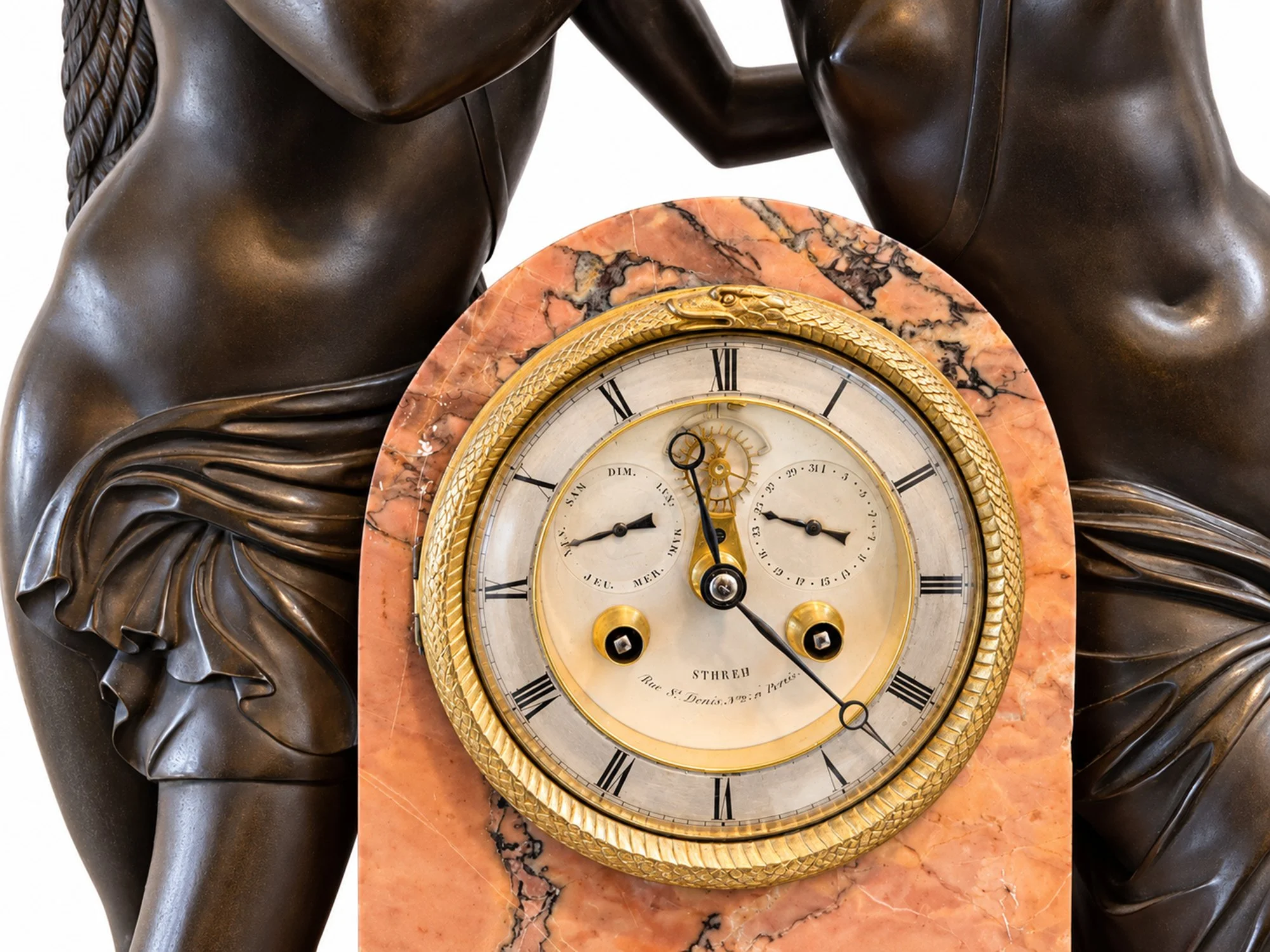
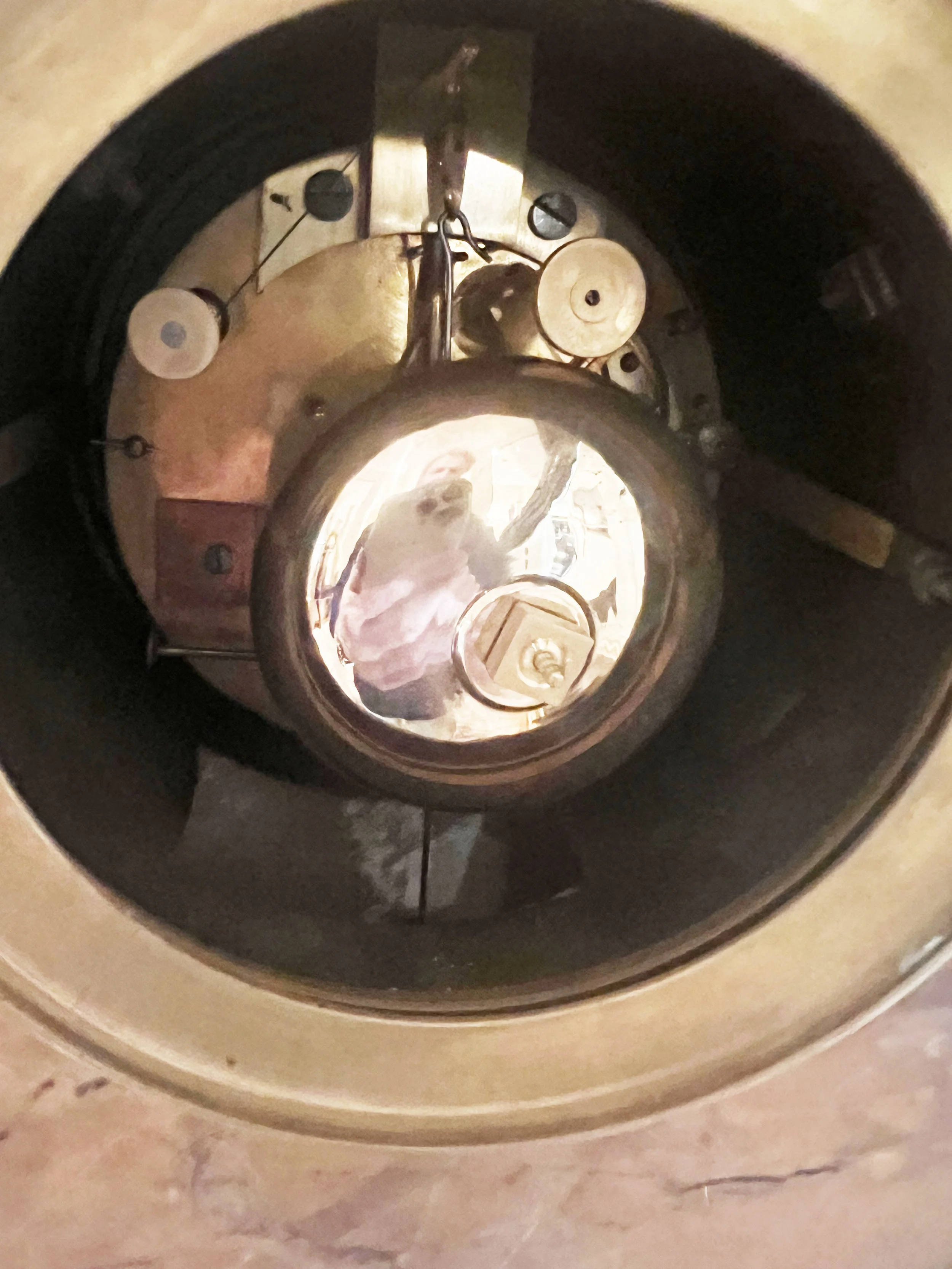
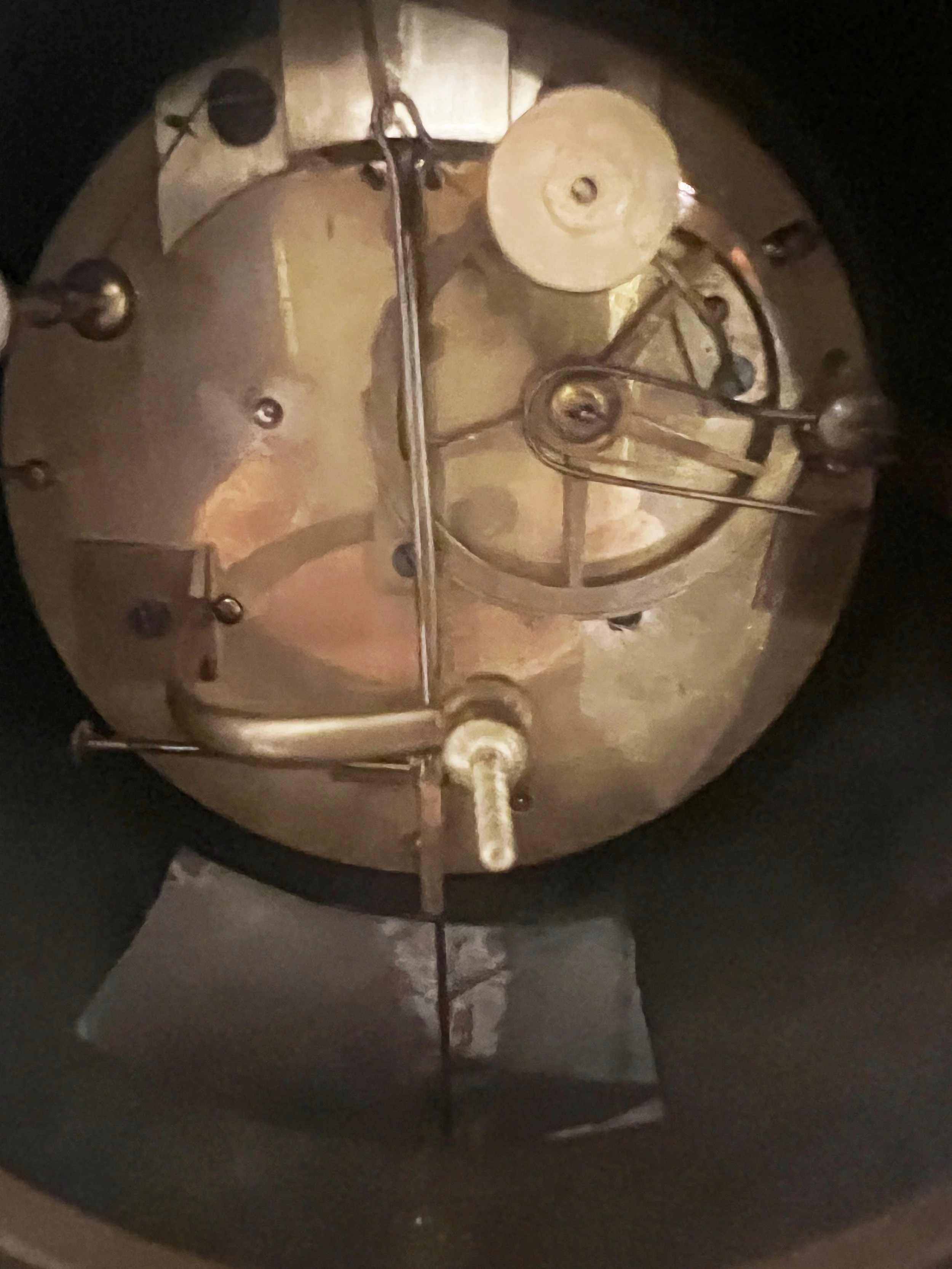
At the center of the marble structure is a circular calendar clock dial enclosed by a gilt-bronze bezel molded with a continuous scale or serpent-like ornament. The silvered chapter ring bears Roman numerals for the hours. Within the central brass dial plate are subsidiary indications for the days of the week and the date of the month, together with a visible portion of the escapement and two winding apertures.
The dial is signed:
STREEL
Rue St. Denis 362. à Paris
The inscription associates the clock with the Parisian horological establishment of Streel on the Rue Saint-Denis. In the absence of a documented movement signature, Streel is most cautiously understood as the Paris clockmaker, retailer, or assembler responsible for the completed timepiece.
The clock and figures rise from a substantial stepped marble platform. The lower tier is enriched by a broad gilt-bronze frieze of repeating acanthus and palmette ornament, while the whole rests upon dark bronze paw-form feet. The pronounced horizontal architecture of the base provides an effective visual foundation for the animated figures above.
Cupid and Psyche
The subject derives from the ancient story of Cupid and Psyche, most famously preserved in Apuleius's Metamorphoses. Psyche, a mortal woman of extraordinary beauty, becomes the beloved of Cupid, the god of love. Their story—one of separation, trials, reconciliation and eventual immortality—became an enduring allegory of the union of Love and the Soul.
The subject enjoyed renewed popularity during the Neoclassical period, when artists and patrons looked to Greek and Roman antiquity for both subject matter and aesthetic models. French sculptors developed numerous interpretations of the pair, ranging from restrained classical compositions to more emotionally charged depictions of embrace and reconciliation.
The present clock belongs to that tradition. Rather than functioning merely as ornament flanking a conventional clock case, Cupid and Psyche form the conceptual and visual core of the entire object. The timepiece emerges from between them, transforming the clock into an allegorical sculpture in which ideas of love, mortality, constancy and the passage of time coexist.
After Claude Michallon
The figural conception relates to a celebrated model associated with Claude Michallon, one of the important French sculptors working during the transition from the late Ancien Régime to the Neoclassical period.
Michallon’s compositions helped establish a vocabulary of idealized classical figures that remained influential well into the nineteenth century. The popularity of such models resulted in later bronze reductions and adaptations, particularly during the Second Empire and early Third Republic, when French foundries revisited eighteenth- and early nineteenth-century sculptural prototypes for an international clientele.
The present clock should therefore be understood not as a simple reproduction, but as a late nineteenth-century reinterpretation of an established French sculptural model. Its transformation into a monumental clock reflects the period’s particular enthusiasm for combining the fine and decorative arts.
Horological Features
The clock is considerably more sophisticated than its sculptural appearance initially suggests.
The dial incorporates:
Roman numeral hour chapters
central hour and minute hands
visible escapement
subsidiary indication for the days of the week
subsidiary indication for the date of the month
twin winding apertures
Paris retailer or maker signature
This combination places the work within the tradition of French calendar clocks, in which additional calendrical information was incorporated into an otherwise conventional spring-driven clock movement.
The visibility of the escapement is particularly effective within this composition. Rather than hiding the mechanism entirely behind a decorative dial, the design allows part of the clock's mechanical operation to become an element of visual interest.
Materials and Construction
The materials are integral to the effect of the clock.
The sculptural figures are cast in patinated bronze, with their dark surfaces emphasizing the modeling of the bodies, hair, wings and drapery. The raised floral wreath provides a contrasting gilt highlight.
The architectural clock case and base are constructed from a richly figured pink variegated marble, selected for dramatic coloration rather than uniformity. Strong black and gray mineral veining travels across the stone, creating a highly individual surface pattern.
Gilt-bronze mounts articulate the transitions between the marble tiers and introduce classical decorative motifs consistent with the historicizing character of the composition.
The combination of bronze and richly colored marble was particularly favored in French luxury furnishings during the nineteenth century. In a work of this scale, those materials give the clock a distinctly architectural quality.
Scale and Presence
At 39½ inches high, the clock is exceptionally large for a domestic timepiece.
Its proportions place it closer to a piece of architectural sculpture than to the conventional mantel clock. The figures extend substantially above and to either side of the clock case, while the broad stepped base gives the composition sufficient visual weight to support them.
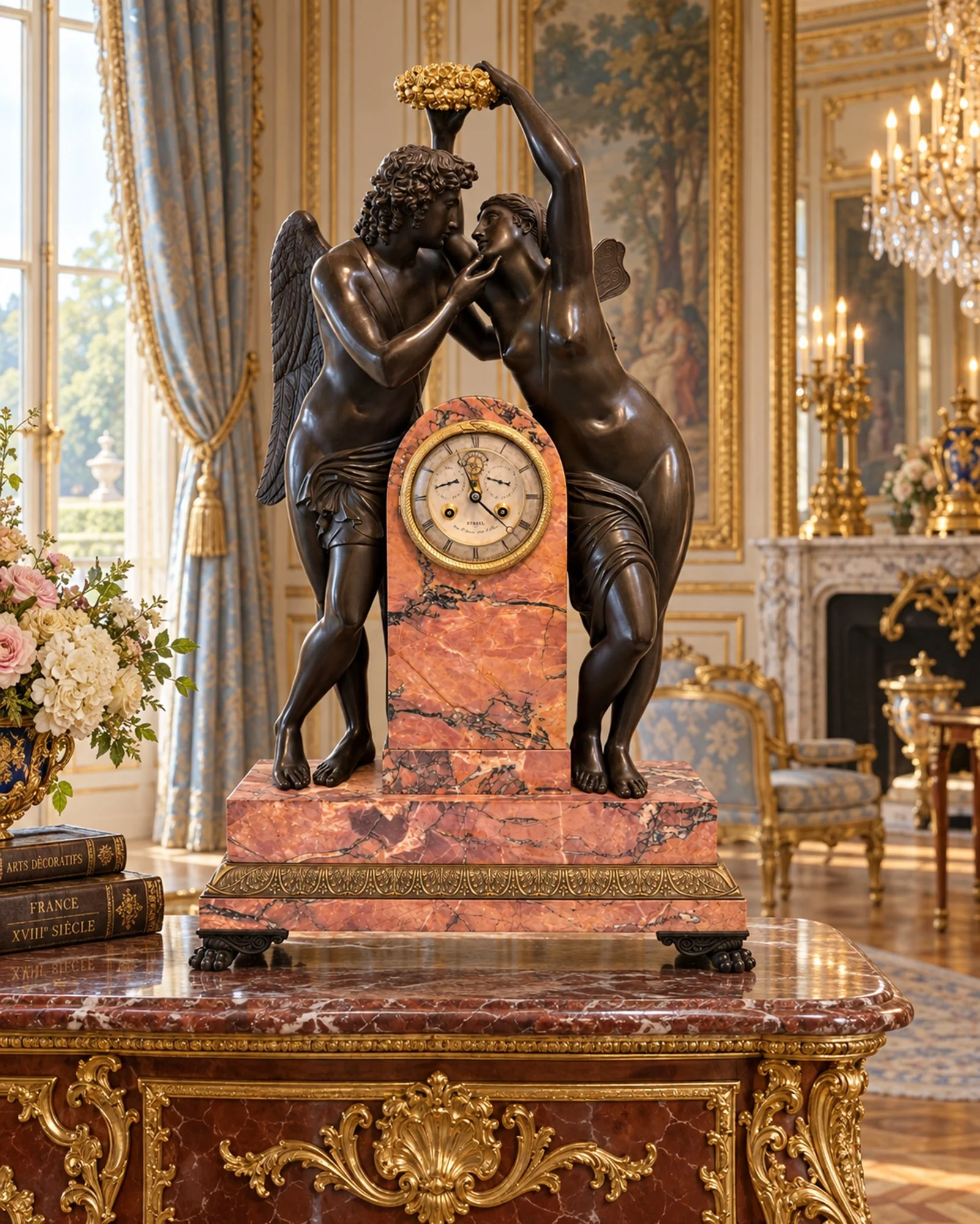
Such clocks were intended for prominent interiors: entrance halls, grand salons, libraries, galleries, or substantial mantelpieces and architectural consoles. They were objects designed to command a room rather than disappear within it.
The clock's approximately meter-high scale also allows the sculptural details to be appreciated independently of the timekeeping mechanism. Viewed from a distance it reads first as a group of Cupid and Psyche; only upon closer examination does its elaborate horological function become apparent.
Historical Context
During the second half of the nineteenth century, Paris became one of the principal international centers for luxury decorative arts. French manufacturers, bronziers, marble workers and clockmakers frequently collaborated to create objects combining historical styles with contemporary mechanical ingenuity.
Large figural clocks occupied a particularly important place within this tradition. Classical mythology provided an almost inexhaustible range of subjects, while bronze and marble allowed makers to create works that evoked ancient sculpture and eighteenth-century French court furnishings simultaneously.
The present clock exemplifies this tradition at an unusually ambitious scale. Its design combines a Neoclassical sculptural model with a late nineteenth-century calendar movement, creating an object that bridges sculpture, decorative art and mechanical engineering.
Condition and Preservation
The clock retains the major elements essential to the original composition, including the paired bronze figures, monumental marble case and plinth, gilt-bronze ornamental elements, calendar dial, visible escapement and subsidiary indications.
The marble displays the natural fissures, veining and tonal variation characteristic of the stone. Minor surface wear to the bronze, gilding and dial is consistent with age and should be understood within the context of a large nineteenth-century decorative object.
Any museum or collector catalogue should distinguish between inherent mineral veining and later structural restoration when documenting the marble in detail.
Provenance
The clock has a documented auction history:
Christie’s, New York, 21 October 2008, Sale 2034, Lot 355.
Inquire about this Clock